9709 P43 - Nov 2016 - Q6
3438
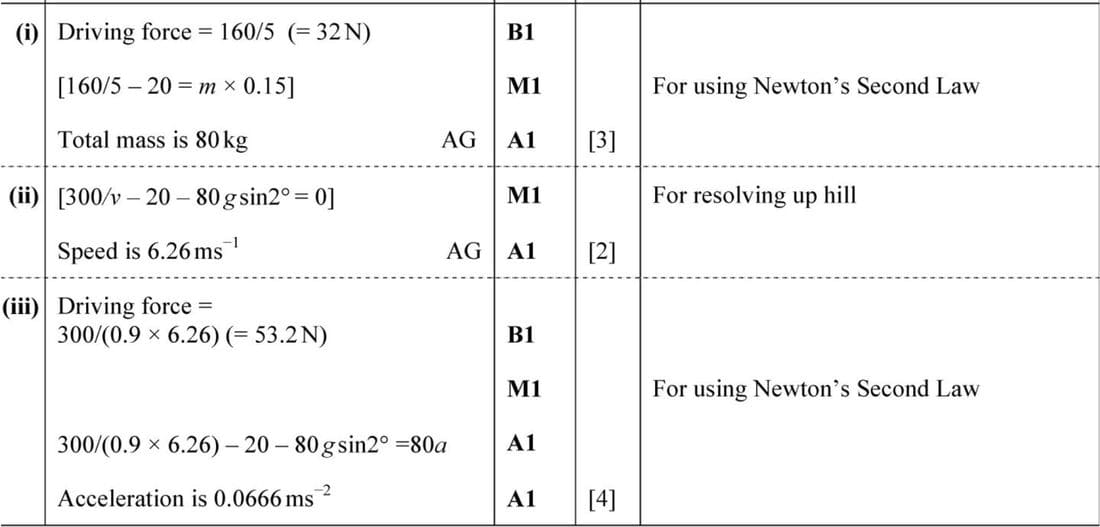
A cyclist is cycling with constant power of 160 W along a horizontal straight road. There is a constant resistance to motion of 20 N. At an instant when the cyclist’s speed is 5 m s-1, his acceleration is 0.15 m s-2.
(i) Show that the total mass of the cyclist and bicycle is 80 kg.
The cyclist comes to a hill inclined at 2° to the horizontal. When the cyclist starts climbing the hill, he increases his power to a constant 300 W. The resistance to motion remains 20 N.
(ii) Show that the steady speed up the hill which the cyclist can maintain when working at this power is 6.26 m s-1, correct to 3 significant figures.
(iii) Find the acceleration at an instant when the cyclist is travelling at 90% of the speed in part (ii).