9709 P42 - Nov 2018 - Q3
3378
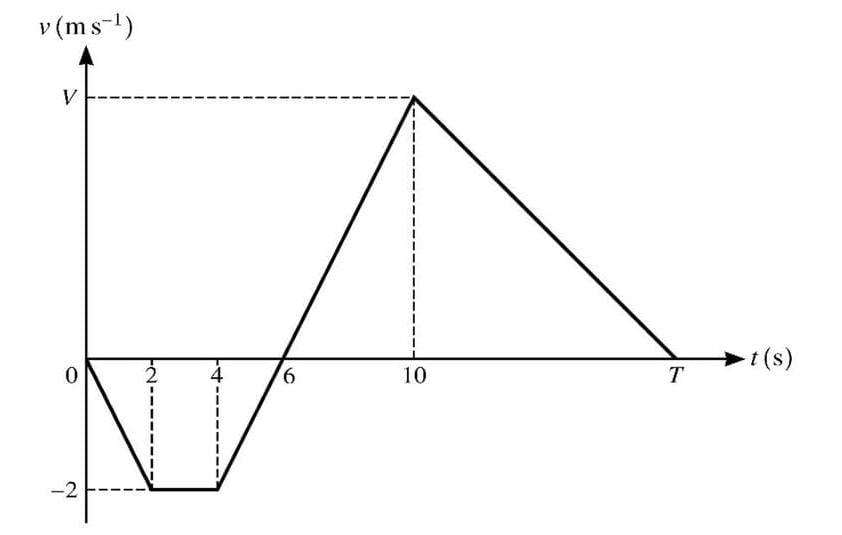
The velocity of a particle moving in a straight line is \(v\) m s-1 at time \(t\) seconds. The diagram shows a velocity-time graph which models the motion of the particle from \(t = 0\) to \(t = T\). The graph consists of four straight line segments. The particle reaches its maximum velocity \(V\) m s-1 at \(t = 10\).
(i) Find the acceleration of the particle during the first 2 seconds.
(ii) Find the value of \(V\).
At \(t = 6\), the particle is instantaneously at rest at the point \(A\). At \(t = T\), the particle comes to rest at the point \(B\). At \(t = 0\) the particle starts from rest at a point one third of the way from \(A\) to \(B\).
(iii) Find the distance \(AB\) and hence find the value of \(T\).
Solutions locked. Please sign in with access to view them.