Browsing as Guest. Progress, bookmarks and attempts are disabled.
Log in to track your work.
Feb/Mar 2019 p42 q5
3377
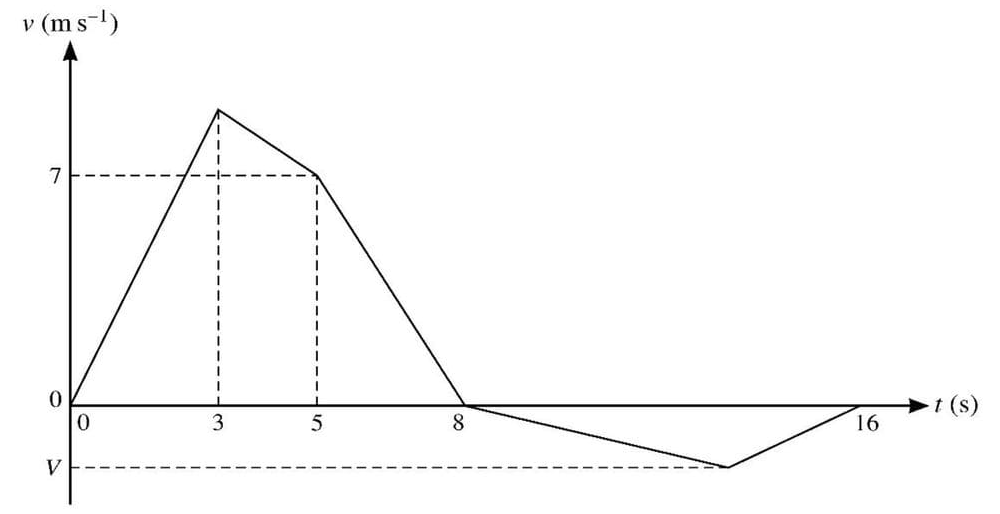
The velocity of a particle moving in a straight line is \(v \text{ m s}^{-1}\) at time \(t\) seconds after leaving a fixed point \(O\). The diagram shows a velocity-time graph which models the motion of the particle from \(t = 0\) to \(t = 16\). The graph consists of five straight line segments. The acceleration of the particle from \(t = 0\) to \(t = 3\) is \(3 \text{ m s}^{-2}\). The velocity of the particle at \(t = 5\) is \(7 \text{ m s}^{-1}\) and it comes to instantaneous rest at \(t = 8\). The particle then comes to rest again at \(t = 16\). The minimum velocity of the particle is \(V \text{ m s}^{-1}\).
(i) Find the distance travelled by the particle in the first 8 s of its motion.
(ii) Given that when the particle comes to rest at \(t = 16\) its displacement from \(O\) is 32 m, find the value of \(V\).
Solution
(i) To find the distance travelled in the first 8 seconds, calculate the area under the velocity-time graph from \(t = 0\) to \(t = 8\).
The velocity at \(t = 3\) is \(3 \times 3 = 9 \text{ m s}^{-1}\).
The area under the graph from \(t = 0\) to \(t = 8\) consists of a triangle and a trapezium:
Area of triangle from \(t = 0\) to \(t = 3\): \(\frac{1}{2} \times 3 \times 9 = 13.5 \text{ m}\).
Area of trapezium from \(t = 3\) to \(t = 8\): \(\frac{1}{2} \times (9 + 7) \times 2 + \frac{1}{2} \times 3 \times 7 = 26.5 \text{ m}\).
Total distance = \(13.5 + 26.5 = 40 \text{ m}\).
(ii) The total displacement from \(t = 0\) to \(t = 16\) is given as 32 m. The distance from \(t = 0\) to \(t = 8\) is 40 m, so the displacement from \(t = 8\) to \(t = 16\) must be \(32 - 40 = -8 \text{ m}\).
The area under the graph from \(t = 8\) to \(t = 16\) is a triangle with base \(8\) and height \(V\).
Area of triangle = \(\frac{1}{2} \times 8 \times V = -8\).