Browsing as Guest. Progress, bookmarks and attempts are disabled.
Log in to track your work.
Nov 2021 p42 q1
3374
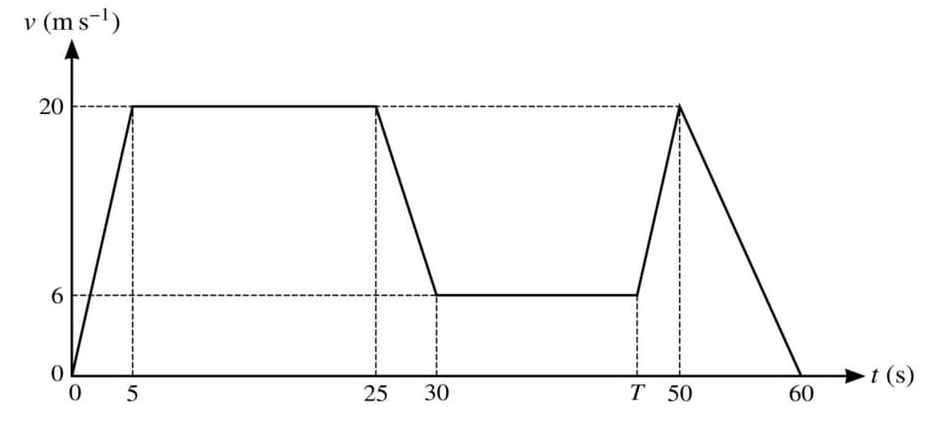
The diagram shows a velocity-time graph which models the motion of a car. The graph consists of six straight line segments. The car accelerates from rest to a speed of 20 m s-1 over a period of 5 s, and then travels at this speed for a further 20 s. The car then decelerates to a speed of 6 m s-1 over a period of 5 s. This speed is maintained for a further (T - 30) s. The car then accelerates again to a speed of 20 m s-1 over a period of (50 - T) s, before decelerating to rest over a period of 10 s.
Given that during the two stages of the motion when the car is accelerating, the accelerations are equal, find the value of T.
Find the total distance travelled by the car during the motion.
Solution
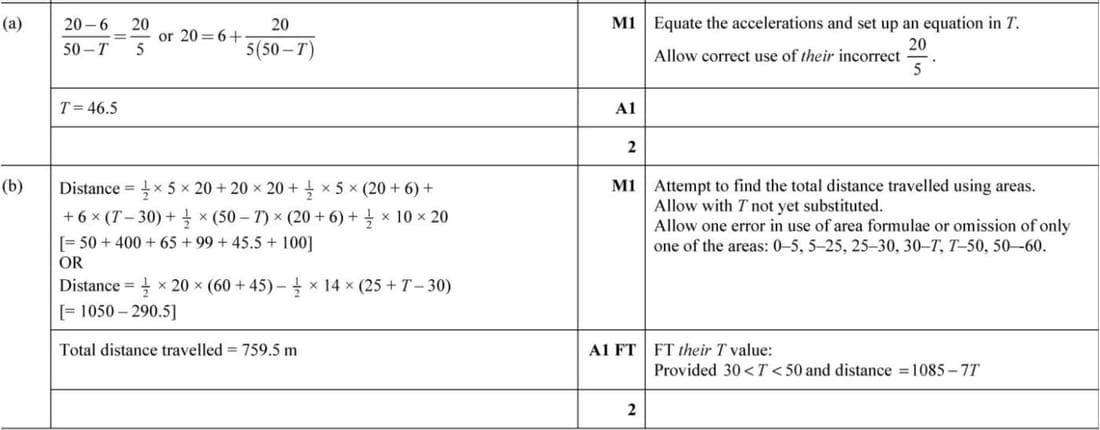
(a) To find the value of T, equate the accelerations during the two acceleration phases. The first acceleration phase is from 0 to 20 m s-1 over 5 s, giving an acceleration of \(\frac{20}{5} = 4\) m s-2. The second acceleration phase is from 6 to 20 m s-1 over (50 - T) s, giving an acceleration of \(\frac{20 - 6}{50 - T} = \frac{14}{50 - T}\) m s-2. Equating these gives:
\(\frac{14}{50 - T} = 4\)
Solving for T:
\(14 = 4(50 - T)\)
\(14 = 200 - 4T\)
\(4T = 186\)
\(T = 46.5\)
(b) To find the total distance travelled, calculate the area under the velocity-time graph. The areas are:
Triangle from 0 to 5 s: \(\frac{1}{2} \times 5 \times 20 = 50\)
Rectangle from 5 to 25 s: \(20 \times 20 = 400\)
Trapezium from 25 to 30 s: \(\frac{1}{2} \times 5 \times (20 + 6) = 65\)
Rectangle from 30 to T s: \(6 \times (T - 30) = 6(T - 30)\)
Trapezium from T to 50 s: \(\frac{1}{2} \times (50 - T) \times (20 + 6) = \frac{1}{2} \times (50 - T) \times 26\)
Triangle from 50 to 60 s: \(\frac{1}{2} \times 10 \times 20 = 100\)
Substitute \(T = 46.5\) into the expression for the total distance: