9709 P43 - Jun 2022 - Q3
3373
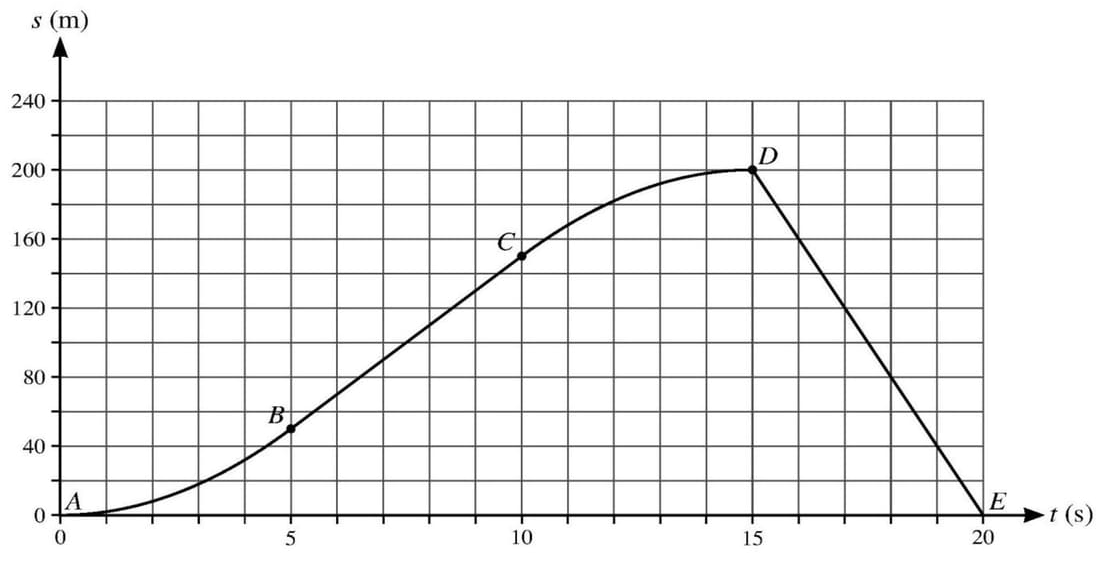
The displacement of a particle moving in a straight line is s metres at time t seconds after leaving a fixed point O. The particle starts from rest and passes through points P, Q and R, at times t = 5, t = 10 and t = 15 respectively, and returns to O at time t = 20. The distances OP, OQ and OR are 50 m, 150 m and 200 m respectively.
The diagram shows a displacement-time graph which models the motion of the particle from t = 0 to t = 20. The graph consists of two curved segments AB and CD and two straight line segments BC and DE.
- Find the speed of the particle between t = 5 and t = 10.
- Find the acceleration of the particle between t = 0 and t = 5, given that it is constant.
- Find the average speed of the particle during its motion.
Solutions locked. Please sign in with access to view them.