9709 P41 - Jun 2023 - Q4 - 8 marks
3372
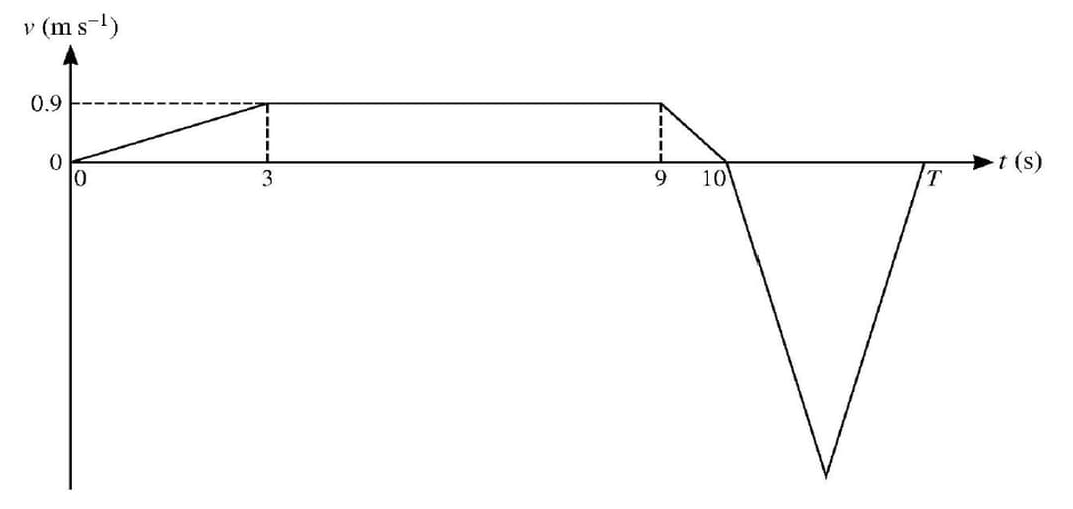
The velocity of a particle at time t s after leaving a fixed point O is v m s-1. The diagram shows a velocity-time graph which models the motion of the particle. The graph consists of 5 straight line segments. The particle accelerates to a speed of 0.9 m s-1 in a period of 3 s, then travels at constant speed for 6 s, and then comes instantaneously to rest 1 s later. The particle then moves back and returns to rest at O at time T s.
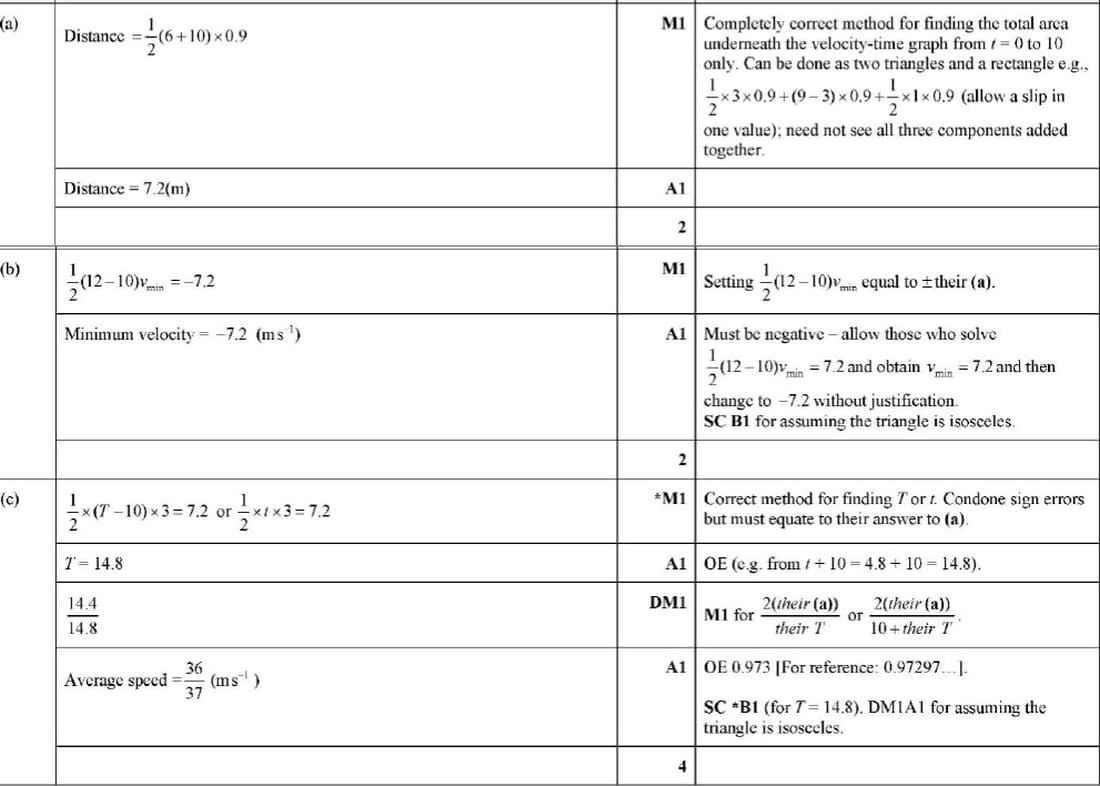
- Find the distance travelled by the particle in the first 10 s of its motion.
- Given that T = 12, find the minimum velocity of the particle.
- Given instead that the greatest speed of the particle is 3 m s-1, find the value of T and hence find the average speed of the particle for the whole of the motion.