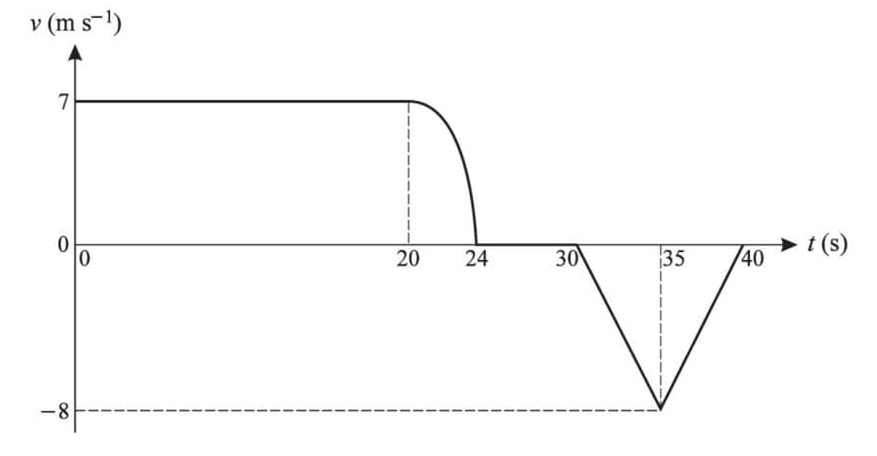
\((i) The distance run by the man in the first 24 seconds is the area under the velocity-time graph from t = 0 to t = 24.\)
\(From t = 0 to t = 20, the velocity is constant at 7 m s-1. The distance covered is:\)
\(20 \times 7 = 140 \text{ m}\)
From t = 20 to t = 24, the velocity decreases linearly from 7 m s-1 to 0 m s-1. The area under this section is a triangle with base 4 s and height 7 m s-1:
\(\frac{1}{2} \times 4 \times 7 = 14 \text{ m}\)
Total distance = 140 + 14 = 154 m. Since the problem states "more than 154 m," we consider the approximation and conclude that the distance is slightly more than 154 m due to the continuous nature of the velocity change.
\((ii) The total distance from A when t = 40 is calculated by considering the areas under the graph:\)
\(From t = 0 to t = 20, the distance is 140 m.\)
\(From t = 20 to t = 24, the distance is given as 20 m.\)
\(From t = 24 to t = 30, the velocity is 0, so no additional distance is covered.\)
From t = 30 to t = 40, the velocity is negative, indicating a return towards A. The area under this section is a triangle with base 10 s and height 8 m s-1:
\(\frac{1}{2} \times 10 \times 8 = 40 \text{ m}\)
Since this is in the negative direction, it subtracts from the total distance:
\(Total distance = 140 + 20 - 40 = 120 m.\)