Browsing as Guest. Progress, bookmarks and attempts are disabled.
Log in to track your work.
June 2003 p4 q3
3370
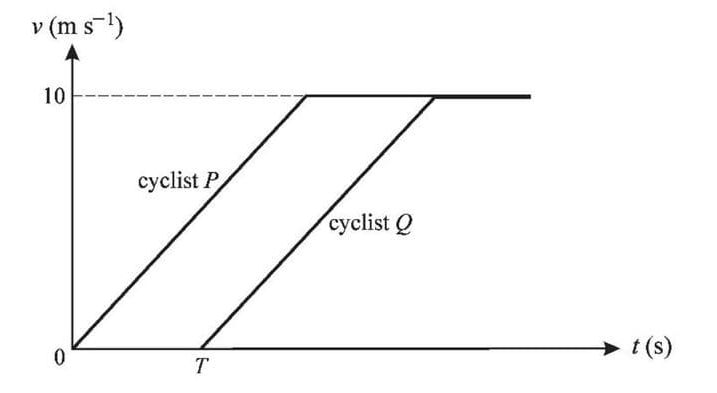
The diagram shows the velocity-time graphs for the motion of two cyclists P and Q, who travel in the same direction along a straight path. Both cyclists start from rest at the same point O and both accelerate at 2 m s-2 up to a speed of 10 m s-1. Both then continue at a constant speed of 10 m s-1. Q starts his journey T seconds after P.
Show in a sketch of the diagram the region whose area represents the displacement of P, from O, at the instant when Q starts.
Given that P has travelled 16 m at the instant when Q starts, find
the value of T,
the distance between P and Q when Q's speed reaches 10 m s-1.
Solution
(i) The region representing the displacement of P from O at the instant when Q starts is the area under the velocity-time graph of P from t = 0 to t = T. This is a triangle with base T and height 2T.
(ii) The displacement of P when Q starts is given as 16 m. The area of the triangle is \\(\frac{1}{2} \times 2T \times T = 16 \\\). Solving for T, we have:
\\(\frac{1}{2} \times 2T^2 = 16 \\\)
\\(T^2 = 16 \\\)
\\(T = 4 \\\)
(iii) The distance between P and Q when Q's speed reaches 10 m s-1 is the area of the parallelogram formed by the velocity-time graph of Q minus the area of the triangle for P. The area of the parallelogram is \\(10 \times 4 = 40 \\\) m. Therefore, the distance is 40 m.