Browsing as Guest. Progress, bookmarks and attempts are disabled.
Log in to track your work.
June 2005 p4 q6
3369
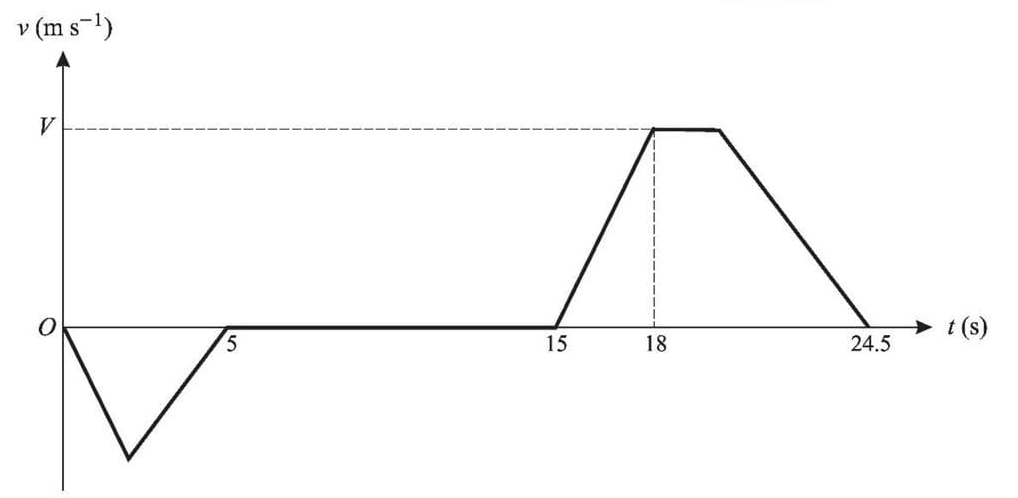
The diagram shows the velocity-time graph for a lift moving between floors in a building. The graph consists of straight line segments. In the first stage the lift travels downwards from the ground floor for 5 s, coming to rest at the basement after travelling 10 m.
(i) Find the greatest speed reached during this stage.
The second stage consists of a 10 s wait at the basement. In the third stage, the lift travels upwards until it comes to rest at a floor 34.5 m above the basement, arriving 24.5 s after the start of the first stage. The lift accelerates at 2 m s-2 for the first 3 s of the third stage, reaching a speed of V m s-1. Find
(ii) the value of V,
(iii) the time during the third stage for which the lift is moving at constant speed,
(iv) the deceleration of the lift in the final part of the third stage.
Solution
(i) The area under the velocity-time graph represents the distance traveled. For the first stage, the area is a triangle with base 5 s and height equal to the greatest speed, which we denote as \(v_{\text{max}}\). The area is \(\frac{1}{2} \times 5 \times v_{\text{max}} = 10\). Solving for \(v_{\text{max}}\), we get \(v_{\text{max}} = 4\) m s-1.
(ii) During the third stage, the lift accelerates at 2 m s-2 for 3 s. Using \(v = u + at\), where \(u = 0\), \(a = 2\), and \(t = 3\), we find \(V = 0 + 2 \times 3 = 6\) m s-1.
(iii) The lift travels 34.5 m in the third stage. The area under the graph for this stage is a trapezium with parallel sides of 9.5 s and \(T\) s, and height 6 m s-1. The area is \(\frac{1}{2} \times (T + 9.5) \times 6 = 34.5\). Solving for \(T\), we find \(T = 2\) s.
(iv) The deceleration is the negative of the gradient of the final part of the third stage. The change in velocity is from 6 m s-1 to 0 m s-1 over a time of \(24.5 - (18 + 2) = 4.5\) s. The deceleration is \(\frac{6}{4.5} = \frac{4}{3}\) m s-2.