Browsing as Guest. Progress, bookmarks and attempts are disabled.
Log in to track your work.
June 2010 p41 q2
3368
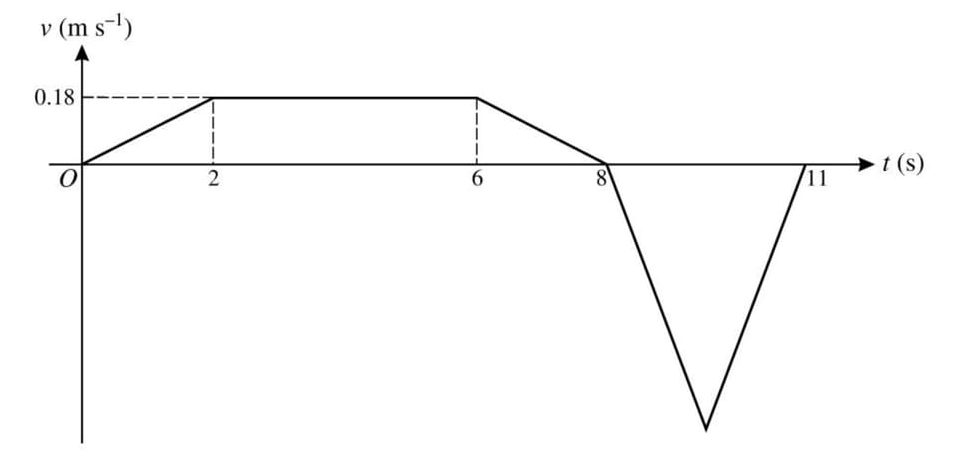
The diagram shows the velocity-time graph for the motion of a machine’s cutting tool. The graph consists of five straight line segments. The tool moves forward for 8 s while cutting and then takes 3 s to return to its starting position. Find
the acceleration of the tool during the first 2 s of the motion,
the distance the tool moves forward while cutting,
the greatest speed of the tool during the return to its starting position.
Solution
(i) The acceleration of the tool during the first 2 s of the motion is calculated using the formula for acceleration, which is the change in velocity divided by the time taken. From the graph, the velocity changes from 0 to 0.18 m/s in 2 seconds. Thus, the acceleration is:
\(a = \frac{0.18 - 0}{2} = 0.09 \text{ m/s}^2\)
(ii) The distance the tool moves forward while cutting is the area under the velocity-time graph from 0 to 8 seconds. This area consists of a triangle from 0 to 2 seconds and a rectangle from 2 to 6 seconds, and another triangle from 6 to 8 seconds. The total distance is:
(iii) The greatest speed of the tool during the return to its starting position is found by equating the area of the triangle during the return (from 8 to 11 seconds) to the area of the trapezium from 0 to 8 seconds. The area of the trapezium is 1.08 m, and the area of the triangle is: