Browsing as Guest. Progress, bookmarks and attempts are disabled.
Log in to track your work.
Nov 2010 p42 q6
3367
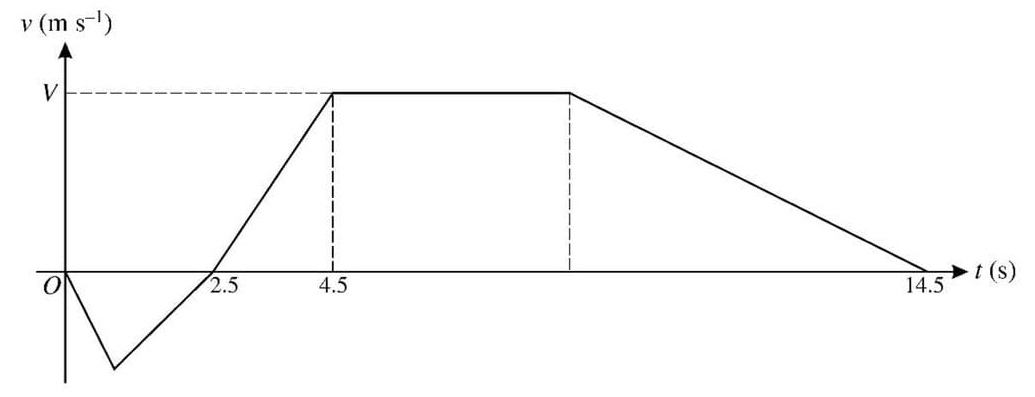
The diagram shows the velocity-time graph for a particle P which travels on a straight line AB, where v ms-1 is the velocity of P at time t s. The graph consists of five straight line segments. The particle starts from rest when t = 0 at a point X on the line between A and B and moves towards A. The particle comes to rest at A when t = 2.5.
(i) Given that the distance XA is 4 m, find the greatest speed reached by P during this stage of the motion.
In the second stage, P starts from rest at A when t = 2.5 and moves towards B. The distance AB is 48 m. The particle takes 12 s to travel from A to B and comes to rest at B. For the first 2 s of this stage P accelerates at 3 m s-2, reaching a velocity of V ms-1. Find
(ii) the value of V,
(iii) the value of t at which P starts to decelerate during this stage,
(iv) the deceleration of P immediately before it reaches B.
Solution
(i) The area under the velocity-time graph from t = 0 to t = 2.5 represents the distance XA. The graph forms a triangle with base 2.5 s and height equal to the maximum speed. Using the formula for the area of a triangle, \(\frac{1}{2} \times 2.5 \times \text{speed}_{\text{max}} = 4\). Solving for \(\text{speed}_{\text{max}}\), we get \(\text{speed}_{\text{max}} = 3.2 \text{ ms}^{-1}\).
(ii) For the first 2 s of the second stage, the particle accelerates at 3 m s-2. Using \(V = u + at\), where \(u = 0\), \(a = 3 \text{ ms}^{-2}\), and \(t = 2 \text{ s}\), we find \(V = 0 + 3 \times 2 = 6 \text{ ms}^{-1}\).
(iii) The total distance from A to B is 48 m. The area under the graph from t = 2.5 to t = 14.5 must equal 48 m. The graph forms a trapezium with a height of 6 ms-1 and bases of 12 s and T s. Using the area of a trapezium, \(\frac{1}{2} \times 6 \times (12 + T) = 48\). Solving for T, we find T = 8.5 s.
(iv) The particle decelerates from V to 0 over the remaining time. Using \(a = \frac{0 - V}{14.5 - 8.5}\), where V = 6 ms-1, we find the deceleration \(a = 1 \text{ ms}^{-2}\).