Browsing as Guest. Progress, bookmarks and attempts are disabled.
Log in to track your work.
Nov 2011 p43 q1
3366
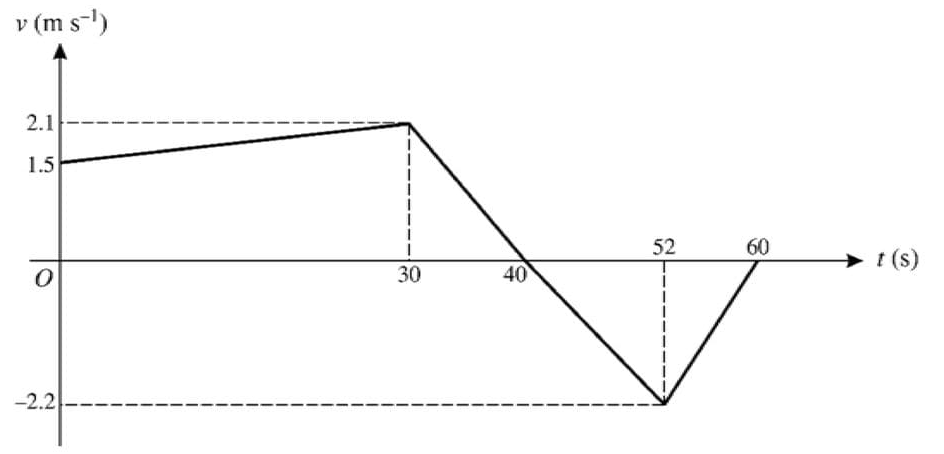
A woman walks in a straight line. The woman’s velocity t seconds after passing through a fixed point A on the line is v m s-1. The graph of v against t consists of 4 straight line segments (see diagram). The woman is at the point B when t = 60. Find
the woman’s acceleration for 0 < t < 30 and for 30 < t < 40,
the distance AB,
the total distance walked by the woman.
Solution
(i) To find the acceleration, we use the formula for acceleration as the gradient of the velocity-time graph.
For 0 < t < 30, the velocity changes from 1.5 m s-1 to 2.1 m s-1 over 30 seconds. Thus, the acceleration is:
\(a = \frac{2.1 - 1.5}{30} = 0.02 \text{ m s}^{-2}\)
For 30 < t < 40, the velocity changes from 2.1 m s-1 to 0 m s-1 over 10 seconds. Thus, the acceleration is:
\(a = \frac{0 - 2.1}{10} = -0.21 \text{ m s}^{-2}\)
\((ii) The distance AB is the area under the velocity-time graph from t = 0 to t = 60.\)
Calculate the area of each segment:
From t = 0 to t = 30: Trapezium with bases 1.5 and 2.1, height 30.