9709 P41 - Nov 2017 - Q4
3364
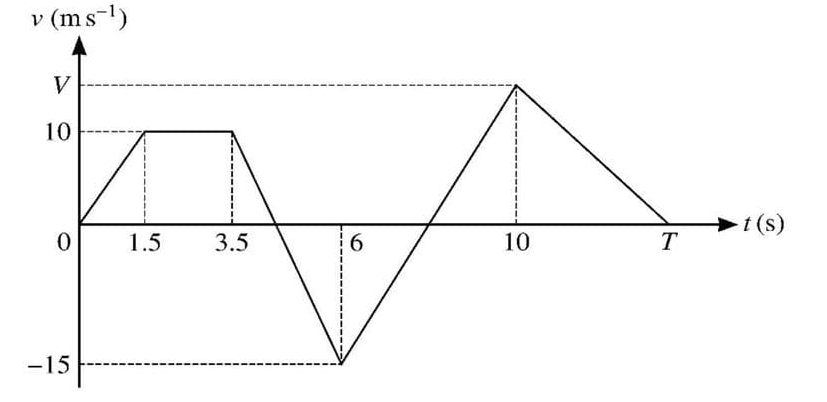
The diagram shows the velocity-time graph of a particle which moves in a straight line. The graph consists of 5 straight line segments. The particle starts from rest at a point A at time \(t = 0\), and initially travels towards point B on the line.
- Show that the acceleration of the particle between \(t = 3.5\) and \(t = 6\) is \(-10 \text{ m s}^{-2}\).
- The acceleration of the particle between \(t = 6\) and \(t = 10\) is \(7.5 \text{ m s}^{-2}\). When \(t = 10\) the velocity of the particle is \(V \text{ m s}^{-1}\). Find the value of \(V\).
- The particle comes to rest at \(B\) at time \(T \text{ s}\). Given that the total distance travelled by the particle between \(t = 0\) and \(t = T\) is \(100 \text{ m}\), find the value of \(T\).
Solutions locked. Please sign in with access to view them.