9709 P43 - Nov 2017 - Q6
3363
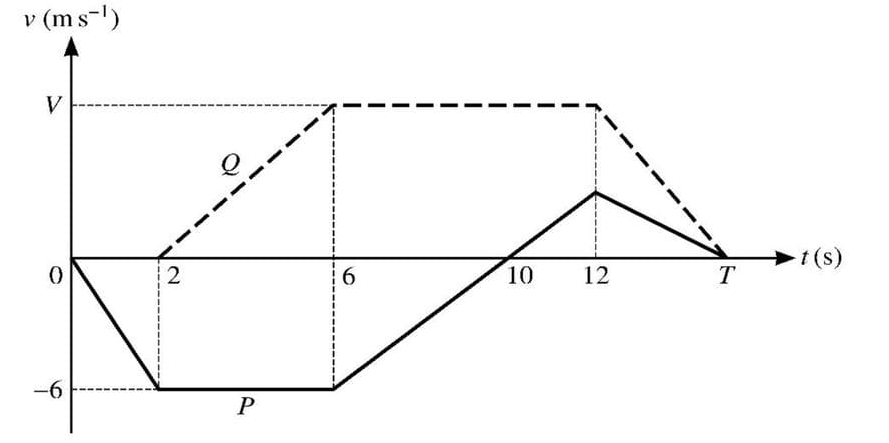
The diagram shows the velocity-time graphs for two particles, P and Q, which are moving in the same straight line. The graph for P consists of four straight line segments. The graph for Q consists of three straight line segments. Both particles start from the same initial position O on the line. Q starts 2 seconds after P and both particles come to rest at time t = T. The greatest velocity of Q is V m s-1.
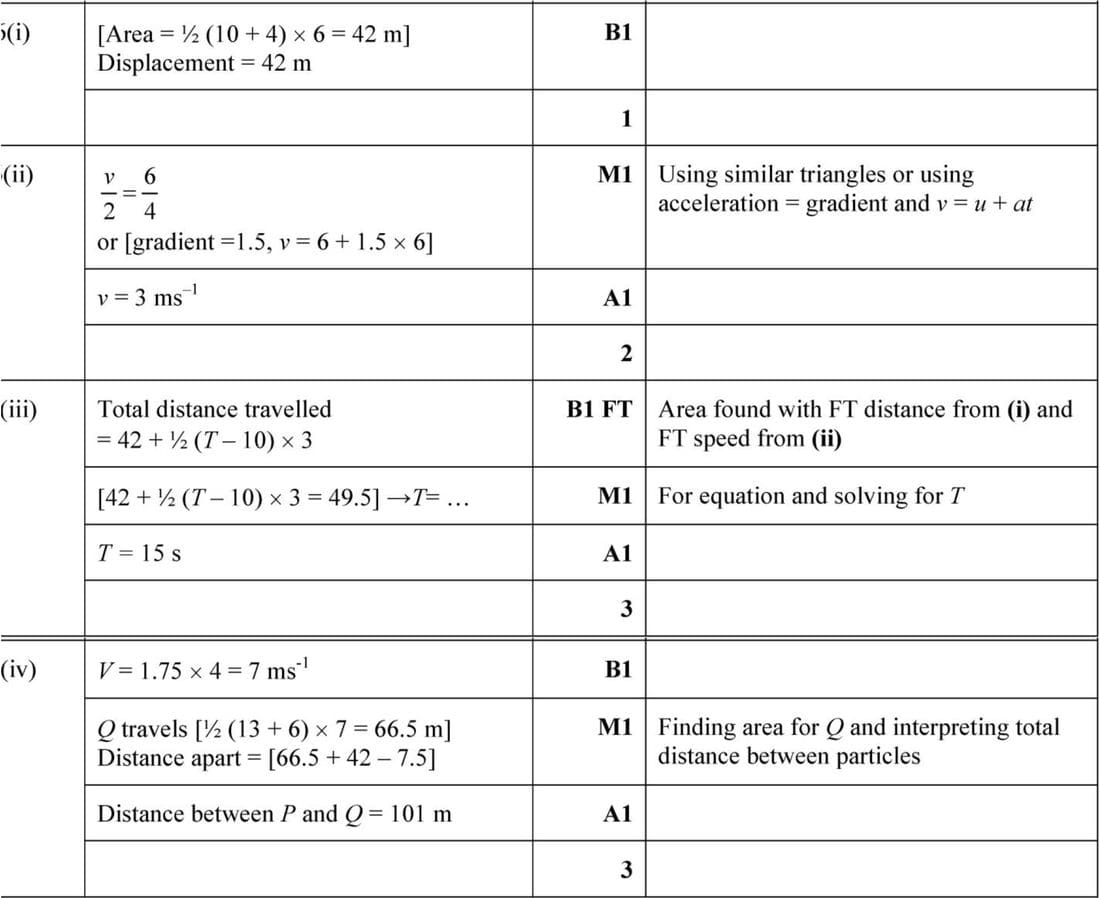
- Find the displacement of P from O at t = 10. [1]
- Find the velocity of P at t = 12. [2]
- Given that the total distance covered by P during the T seconds of its motion is 49.5 m, find the value of T. [3]
- Given also that the acceleration of Q from t = 2 to t = 6 is 1.75 m s-2, find the value of V and hence find the distance between the two particles when they both come to rest at t = T. [3]