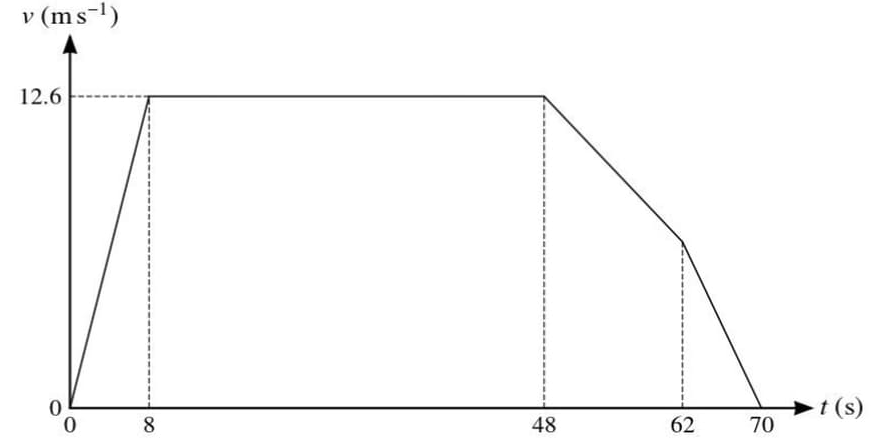
(a) The distance covered in the first 8 seconds is the area of the triangle under the velocity-time graph. The formula for the area of a triangle is \(\frac{1}{2} \times \text{base} \times \text{height}\). Here, the base is 8 seconds and the height is 12.6 m/s.
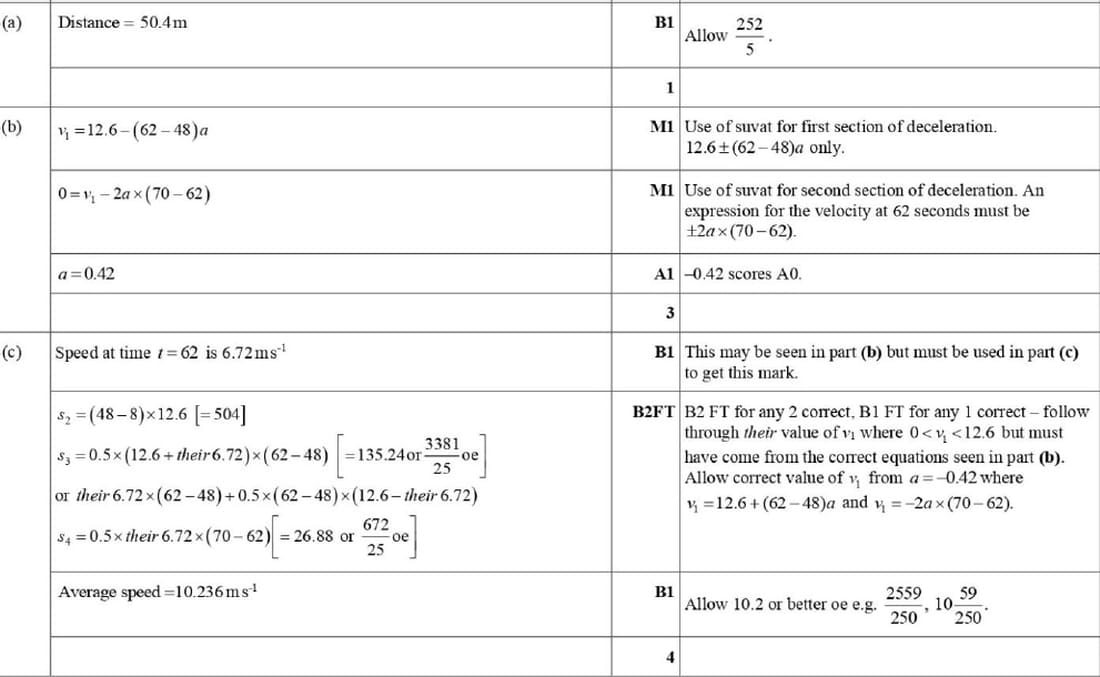
\(\text{Distance} = \frac{1}{2} \times 8 \times 12.6 = 50.4 \text{ m}\)
(b) To find \(a\), use the equations of motion for the deceleration phase. From 48 to 62 seconds, the velocity decreases from 12.6 m/s to \(v_1\).
\(v_1 = 12.6 - (62 - 48)a\)
From 62 to 70 seconds, the velocity decreases from \(v_1\) to 0.
\(0 = v_1 - 2a \times (70 - 62)\)
Substituting \(v_1\) from the first equation into the second gives:
\(0 = (12.6 - 14a) - 16a\)
\(0 = 12.6 - 30a\)
\(a = \frac{12.6}{30} = 0.42\)
(c) The average speed is the total distance divided by the total time. Calculate the distance for each segment:
\(s_1 = 50.4 \text{ m}\) (from part a)
\(s_2 = (48 - 8) \times 12.6 = 504 \text{ m}\)
\(s_3 = 0.5 \times (12.6 + 6.72) \times (62 - 48) = 135.24 \text{ m}\)
\(s_4 = 0.5 \times 6.72 \times (70 - 62) = 26.88 \text{ m}\)
Total distance \(s = s_1 + s_2 + s_3 + s_4 = 50.4 + 504 + 135.24 + 26.88 = 716.52 \text{ m}\)
\(Total time = 70 seconds\)
Average speed = \(\frac{716.52}{70} = 10.236 \text{ m/s}\)