June 2017 p41 q5
3360
A particle P moves in a straight line ABCD with constant deceleration. The velocities of P at A, B, and C are 20 m/s, 12 m/s, and 6 m/s respectively.
- Find the ratio of distances AB : BC.
- The particle comes to rest at D. Given that the distance AD is 80 m, find the distance BC.
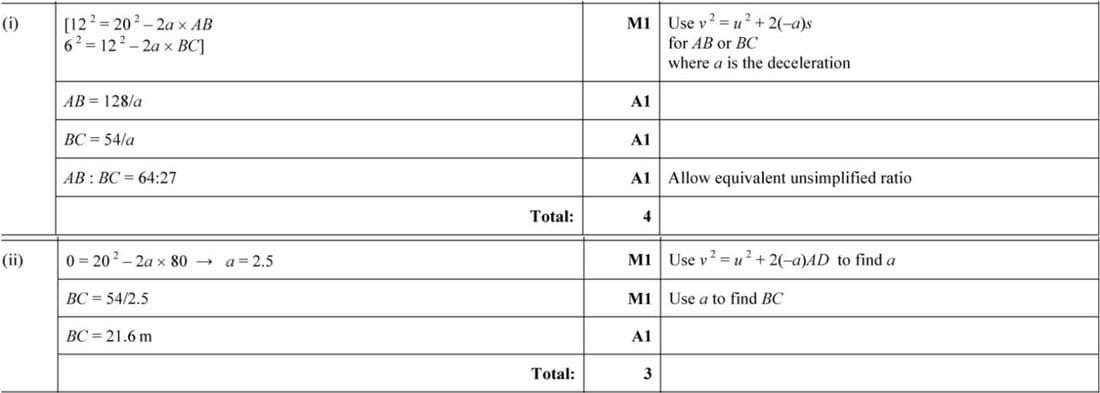
Solution
(i) To find the ratio of distances AB : BC, we use the equation of motion:
\(v^2 = u^2 + 2(-a)s\)
For AB: \(12^2 = 20^2 - 2a \times AB\)
\(144 = 400 - 2a \times AB\)
\(2a \times AB = 256\)
\(AB = \frac{128}{a}\)
For BC: \(6^2 = 12^2 - 2a \times BC\)
\(36 = 144 - 2a \times BC\)
\(2a \times BC = 108\)
\(BC = \frac{54}{a}\)
The ratio \(AB : BC = \frac{128/a}{54/a} = \frac{128}{54} = \frac{64}{27}\).
(ii) To find the distance BC, we first find the deceleration \(a\) using the entire distance AD:
\(0 = 20^2 - 2a \times 80\)
\(0 = 400 - 160a\)
\(a = 2.5\)
Now, substitute \(a\) back to find BC:
\(BC = \frac{54}{2.5} = 21.6 \text{ m}\).
Log in to record attempts.