Let the random variable \(X\) represent the number of residents who rate the service as 'good'. \(X\) follows a binomial distribution with parameters \(n = 125\) and \(p = 0.52\).
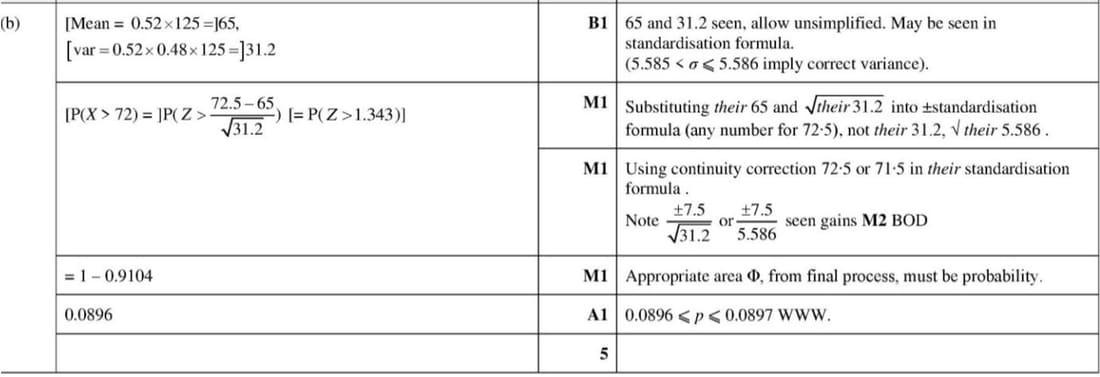
To approximate this binomial distribution, we use a normal distribution with mean \(\mu = np = 0.52 \times 125 = 65\) and variance \(\sigma^2 = np(1-p) = 0.52 \times 0.48 \times 125 = 31.2\).
Thus, \(X \sim N(65, 31.2)\).
We need to find \(P(X > 72)\). Using a continuity correction, this is approximated by \(P(X > 72.5)\).
Standardize the variable: \(Z = \frac{X - \mu}{\sigma} = \frac{72.5 - 65}{\sqrt{31.2}} \approx 1.343\).
Thus, \(P(X > 72.5) = P(Z > 1.343) = 1 - P(Z \leq 1.343)\).
Using standard normal distribution tables, \(P(Z \leq 1.343) \approx 0.9104\).
Therefore, \(P(Z > 1.343) = 1 - 0.9104 = 0.0896\).
Hence, the probability that more than 72 residents rate the service as 'good' is approximately between 0.0896 and 0.0897.