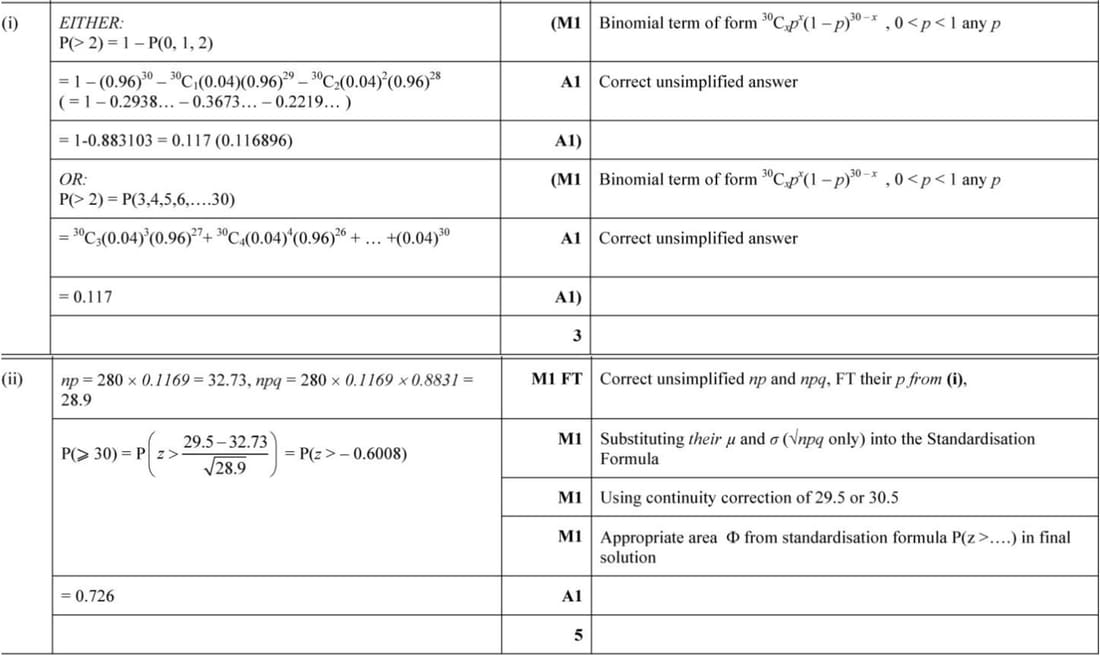
(i) The number of faulty CDs in a box follows a binomial distribution with parameters \(n = 30\) and \(p = 0.04\). We need to find \(P(X > 2)\), where \(X\) is the number of faulty CDs.
\(P(X > 2) = 1 - P(X \leq 2) = 1 - (P(X = 0) + P(X = 1) + P(X = 2))\)
\(P(X = 0) = \binom{30}{0} (0.04)^0 (0.96)^{30}\)
\(P(X = 1) = \binom{30}{1} (0.04)^1 (0.96)^{29}\)
\(P(X = 2) = \binom{30}{2} (0.04)^2 (0.96)^{28}\)
Calculating these probabilities:
\(P(X = 0) = 0.2938\)
\(P(X = 1) = 0.3673\)
\(P(X = 2) = 0.2219\)
\(P(X > 2) = 1 - (0.2938 + 0.3673 + 0.2219) = 0.117\)
(ii) Let \(Y\) be the number of rejected boxes out of 280. \(Y\) follows a binomial distribution with parameters \(n = 280\) and \(p = 0.117\) (from part (i)).
We approximate \(Y\) using a normal distribution with mean \(\mu = np = 280 \times 0.117 = 32.73\) and variance \(\sigma^2 = np(1-p) = 280 \times 0.117 \times 0.883 = 28.9\).
Using the normal approximation, we find \(P(Y \geq 30)\) with continuity correction:
\(P(Y \geq 30) = P\left( Z \geq \frac{29.5 - 32.73}{\sqrt{28.9}} \right) = P(Z \geq -0.6008)\)
Using standard normal distribution tables, \(P(Z \geq -0.6008) = 0.726\).