The random variable X is such that \(X \sim N(82, 126)\).
(ii) Five independent observations of X are taken. Find the probability that at most one of them is greater than 87.
(iii) Find the value of k such that \(P(87 < X < k) = 0.3\).
Solution
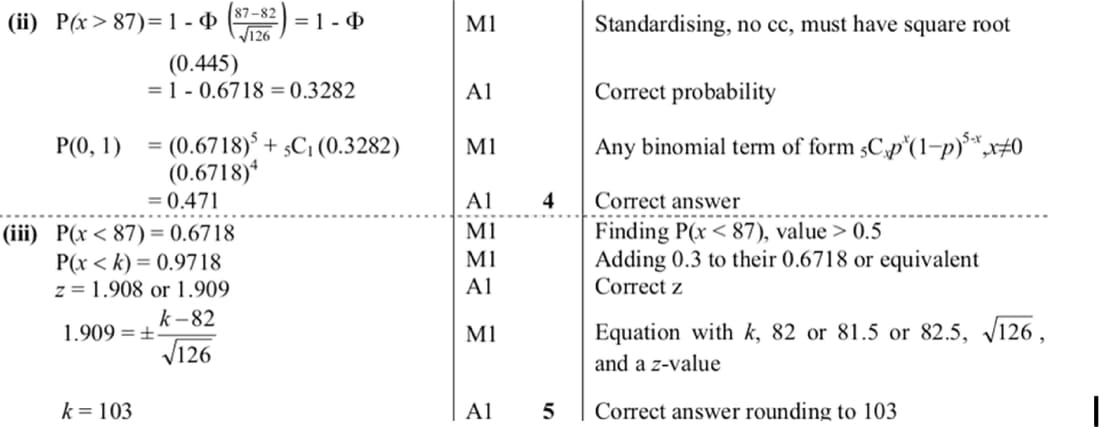
(ii) To find the probability that at most one of the five observations is greater than 87, we first find \(P(X > 87)\).
Standardize: \(P(X > 87) = 1 - \Phi \left( \frac{87 - 82}{\sqrt{126}} \right)\)
\(= 1 - \Phi(0.445) = 1 - 0.6718 = 0.3282\)
Using the binomial distribution for 5 trials, \(P(0, 1) = (0.6718)^5 + \binom{5}{1} (0.6718)^4 (0.3282)\)
\(= 0.471\)
(iii) We need to find \(k\) such that \(P(87 < X < k) = 0.3\).
First, find \(P(X < 87) = 0.6718\).
Then, \(P(X < k) = 0.6718 + 0.3 = 0.9718\).
Find the corresponding \(z\)-value: \(z = 1.908\) or \(1.909\).
Use the equation: \(1.909 = \frac{k - 82}{\sqrt{126}}\)
Solve for \(k\): \(k = 103\).
Log in to record attempts.