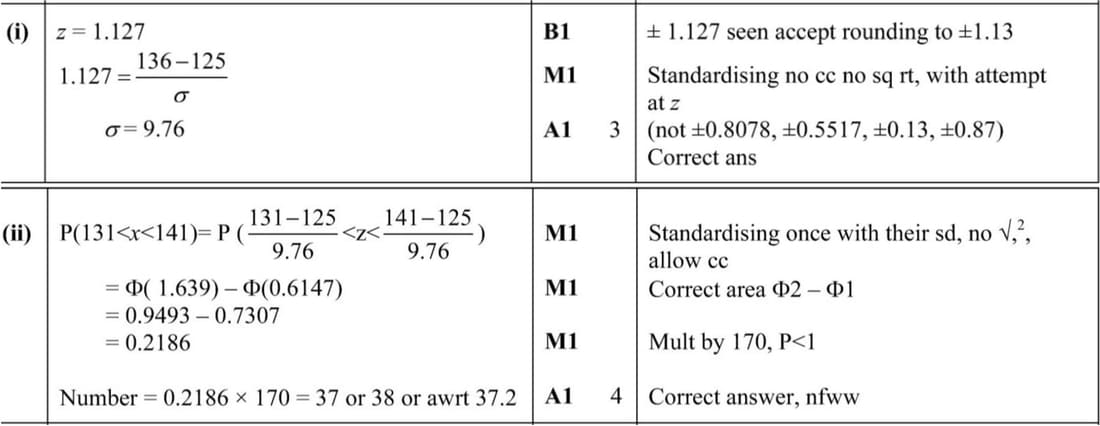
(i) To find \(\sigma\), we use the standard normal distribution. Given that 13% of seeds take longer than 136 hours, we find the corresponding \(z\)-value for 0.87 (since 1 - 0.13 = 0.87) in the standard normal distribution table, which is approximately 1.127.
Using the formula for standardization:
\(z = \frac{136 - 125}{\sigma}\)
Substitute \(z = 1.127\):
\(1.127 = \frac{136 - 125}{\sigma}\)
\(\sigma = \frac{11}{1.127} \approx 9.76\)
(ii) To find the expected number of seeds taking between 131 and 141 hours, we standardize these values:
\(P(131 < x < 141) = P\left( \frac{131 - 125}{9.76} < z < \frac{141 - 125}{9.76} \right)\)
\(= P(0.6147 < z < 1.639)\)
Using the standard normal distribution table:
\(\Phi(1.639) - \Phi(0.6147) = 0.9493 - 0.7307 = 0.2186\)
The expected number of seeds is:
\(0.2186 \times 170 \approx 37.2\)
Thus, the expected number of seeds is 37 or 38.