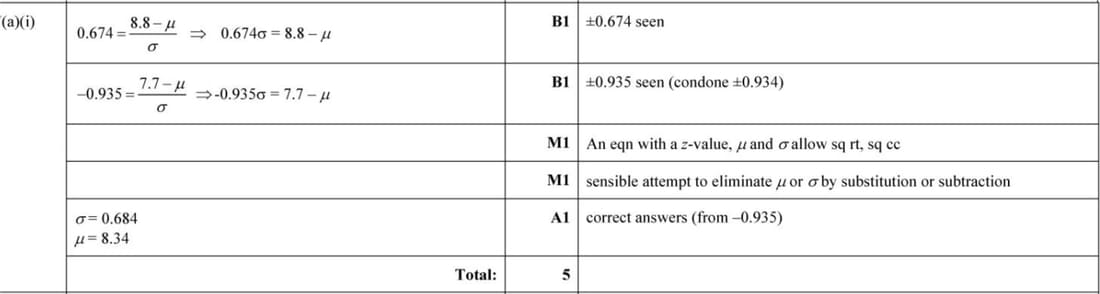
Given that 25% of women have fingers longer than 8.8 cm, the corresponding z-score is \(z = 0.674\) (since 75% is below 8.8 cm).
Using the z-score formula: \(z = \frac{X - \mu}{\sigma}\), we have:
\(0.674 = \frac{8.8 - \mu}{\sigma}\)
\(0.674\sigma = 8.8 - \mu\)
Similarly, for 17.5% having fingers shorter than 7.7 cm, the z-score is \(z = -0.935\).
\(-0.935 = \frac{7.7 - \mu}{\sigma}\)
\(-0.935\sigma = 7.7 - \mu\)
We now have two equations:
- \(0.674\sigma = 8.8 - \mu\)
- \(-0.935\sigma = 7.7 - \mu\)
Subtract the second equation from the first:
\(0.674\sigma + 0.935\sigma = 8.8 - 7.7\)
\(1.609\sigma = 1.1\)
\(\sigma = \frac{1.1}{1.609} \approx 0.684\)
Substitute \(\sigma = 0.684\) back into the first equation:
\(0.674 \times 0.684 = 8.8 - \mu\)
\(0.461 = 8.8 - \mu\)
\(\mu = 8.8 - 0.461\)
\(\mu = 8.34\)