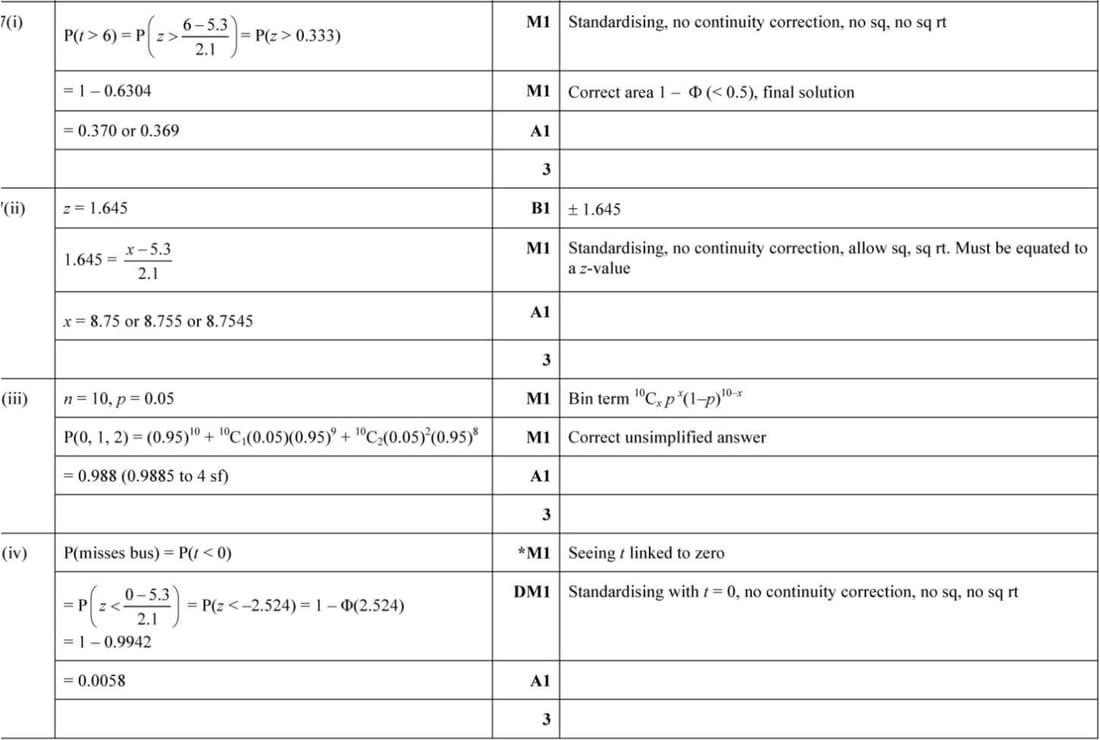
(i) To find the probability that Josie has to wait longer than 6 minutes, we standardize the normal variable:
\(P(T > 6) = P\left( Z > \frac{6 - 5.3}{2.1} \right) = P(Z > 0.333)\)
Using the standard normal distribution table, \(P(Z > 0.333) = 1 - \Phi(0.333) = 1 - 0.6304 = 0.3696\). Therefore, the probability is approximately 0.370 or 0.369.
(ii) For 5% of days, Josie waits longer than \(x\) minutes, so \(P(T > x) = 0.05\). This corresponds to a \(z\)-value of 1.645. Standardizing gives:
\(1.645 = \frac{x - 5.3}{2.1}\)
Solving for \(x\), we get \(x = 1.645 \times 2.1 + 5.3 = 8.7545\). Thus, \(x \approx 8.75\) or \(8.755\).
(iii) The probability that Josie waits longer than \(x\) minutes on fewer than 3 days in 10 days is a binomial probability problem with \(n = 10\) and \(p = 0.05\). We calculate:
\(P(0, 1, 2) = (0.95)^{10} + \binom{10}{1}(0.05)(0.95)^9 + \binom{10}{2}(0.05)^2(0.95)^8\)
\(= 0.988\) (0.9885 to 4 significant figures).
(iv) The probability that Josie misses the bus is \(P(T < 0)\). Standardizing gives:
\(P\left( Z < \frac{0 - 5.3}{2.1} \right) = P(Z < -2.524)\)
Using the standard normal distribution table, \(P(Z < -2.524) = 1 - \Phi(2.524) = 1 - 0.9942 = 0.0058\).