Browsing as Guest. Progress, bookmarks and attempts are disabled.
Log in to track your work.
June 2004 p6 q4
3165
Melons are sold in three sizes: small, medium and large. The weights follow a normal distribution with mean 450 grams and standard deviation 120 grams. Melons weighing less than 350 grams are classified as small.
Find the proportion of melons which are classified as small.
The rest of the melons are divided in equal proportions between medium and large. Find the weight above which melons are classified as large.
Solution
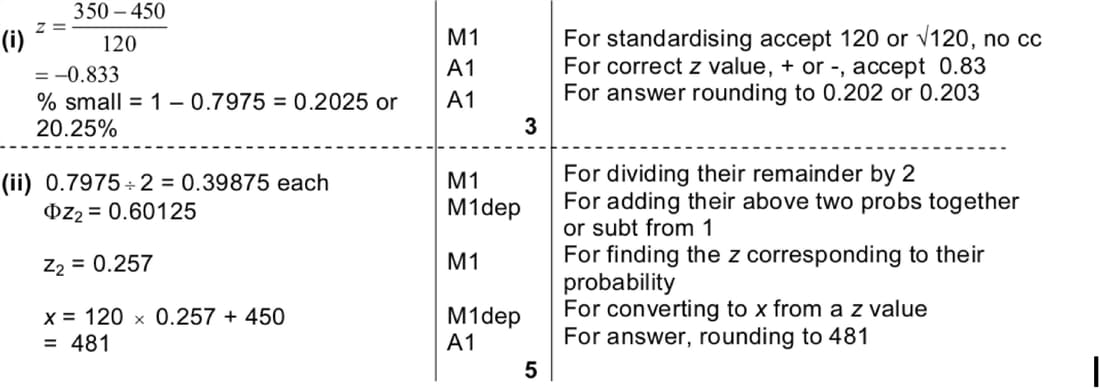
(i) To find the proportion of melons classified as small, we calculate the z-score for 350 grams using the formula:
\(z = \frac{350 - 450}{120} = -0.833\)
The proportion of melons weighing less than 350 grams is given by the cumulative distribution function (CDF) for a standard normal distribution at \(z = -0.833\). From standard normal distribution tables, \(\Phi(-0.833) \approx 0.2025\). Therefore, the proportion of melons classified as small is 20.25%.
(ii) The remaining melons are divided equally between medium and large. The proportion of melons not classified as small is \(1 - 0.2025 = 0.7975\). Half of these are classified as large, so the proportion classified as large is \(0.7975 / 2 = 0.39875\).
We need to find the z-score corresponding to a cumulative probability of \(1 - 0.39875 = 0.60125\). From standard normal distribution tables, \(z \approx 0.257\).
Convert this z-score back to the original scale using:
\(x = 120 \times 0.257 + 450 = 481\)
Thus, the weight above which melons are classified as large is 481 grams.