The random variable X can take only the values -2, -1, 0, 1, 2. The probability distribution of X is given in the following table.
\(Given that P(X \geq 0) = 3P(X < 0), find the values of p and q.\)
Solution
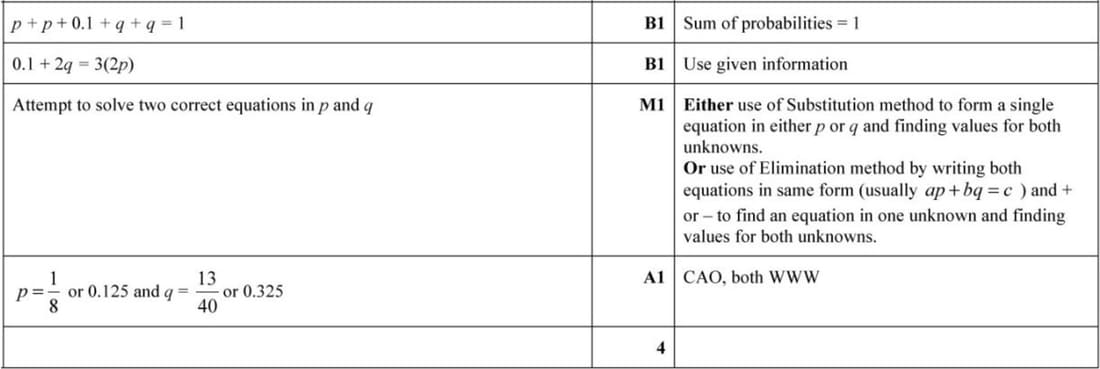
The sum of all probabilities must equal 1:
\(p + p + 0.1 + q + q = 1\)
Simplifying, we get:
\(2p + 0.1 + 2q = 1\)
Given that \(P(X \geq 0) = 3P(X < 0)\), we have:
\(0.1 + 2q = 3(2p)\)
Now, solve the system of equations:
- \(2p + 0.1 + 2q = 1\)
- \(0.1 + 2q = 6p\)
From equation (2), express \(q\) in terms of \(p\):
\(2q = 6p - 0.1\)
\(q = 3p - 0.05\)
Substitute \(q = 3p - 0.05\) into equation (1):
\(2p + 0.1 + 2(3p - 0.05) = 1\)
\(2p + 0.1 + 6p - 0.1 = 1\)
\(8p = 1\)
\(p = \frac{1}{8}\)
Substitute \(p = \frac{1}{8}\) back to find \(q\):
\(q = 3 \times \frac{1}{8} - 0.05\)
\(q = \frac{3}{8} - \frac{1}{20}\)
\(q = \frac{15}{40} - \frac{2}{40}\)
\(q = \frac{13}{40}\)
Log in to record attempts.