Browsing as Guest. Progress, bookmarks and attempts are disabled.
Log in to track your work.
Nov 2020 p51 q4
2894
The random variable X takes each of the values 1, 2, 3, 4 with probability \(\frac{1}{4}\). Two independent values of X are chosen at random. If the two values of X are the same, the random variable Y takes that value. Otherwise, the value of Y is the larger value of X minus the smaller value of X.
(a) Draw up the probability distribution table for Y.
\((b) Find the probability that Y = 2 given that Y is even.\)
Solution
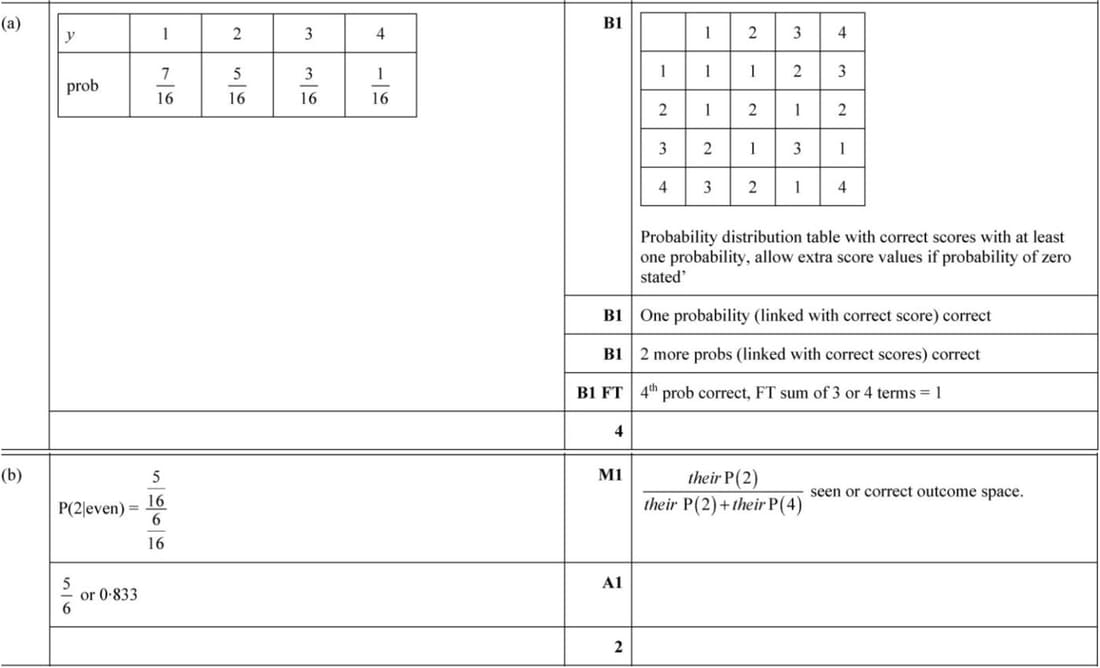
(a) To find the probability distribution of Y, consider all possible pairs of X values:
\((1,1)\), \((2,2)\), \((3,3)\), \((4,4)\): Y takes the value 1, 2, 3, 4 respectively.
\((1,2)\), \((2,1)\): Y = 1.
\((1,3)\), \((3,1)\): Y = 2.
\((1,4)\), \((4,1)\): Y = 3.
\((2,3)\), \((3,2)\): Y = 1.
\((2,4)\), \((4,2)\): Y = 2.
\((3,4)\), \((4,3)\): Y = 1.
Calculate probabilities:
\(P(Y=1) = \frac{7}{16}\)
\(P(Y=2) = \frac{5}{16}\)
\(P(Y=3) = \frac{3}{16}\)
\(P(Y=4) = \frac{1}{16}\)
(b) Given Y is even, possible values are 2 and 4. Calculate:
\(P(Y=2 \mid Y \text{ is even}) = \frac{P(Y=2)}{P(Y=2) + P(Y=4)} = \frac{\frac{5}{16}}{\frac{5}{16} + \frac{1}{16}} = \frac{5}{6}\)