Browsing as Guest. Progress, bookmarks and attempts are disabled.
Log in to track your work.
June 2012 p62 q5
2862
An English examination consists of 8 questions in Part A and 3 questions in Part B. Candidates must choose 6 questions. The order in which questions are chosen does not matter. Find the number of ways in which the 6 questions can be chosen in each of the following cases.
There are no restrictions on which questions can be chosen.
Candidates must choose at least 4 questions from Part A.
Candidates must either choose both question 1 and question 2 in Part A, or choose neither of these questions.
Solution
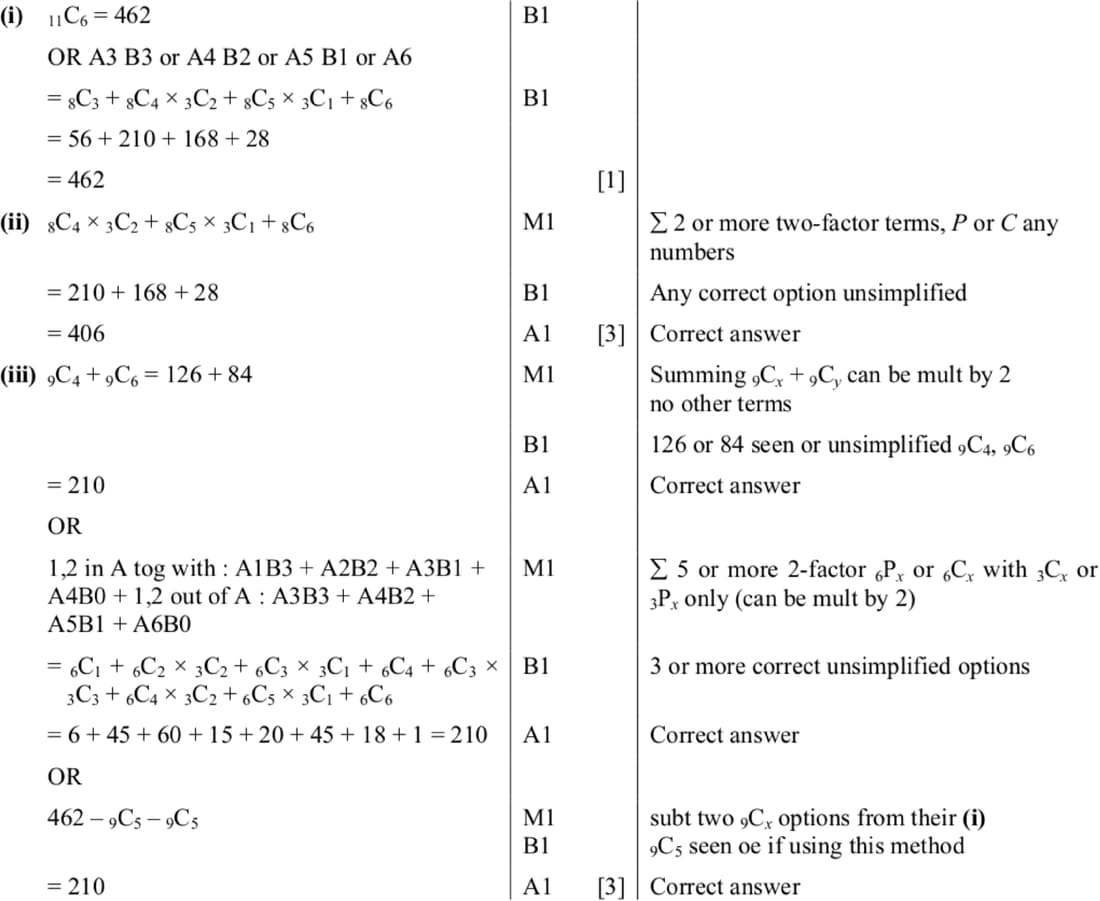
(i) There are 11 questions in total (8 from Part A and 3 from Part B). The number of ways to choose 6 questions from 11 is given by the combination formula:
\(\binom{11}{6} = 462\)
(ii) Candidates must choose at least 4 questions from Part A. We consider the following cases:
4 questions from Part A and 2 from Part B: \(\binom{8}{4} \times \binom{3}{2} = 70 \times 3 = 210\)
5 questions from Part A and 1 from Part B: \(\binom{8}{5} \times \binom{3}{1} = 56 \times 3 = 168\)
6 questions from Part A: \(\binom{8}{6} = 28\)
Adding these gives: \(210 + 168 + 28 = 406\)
(iii) Candidates must either choose both question 1 and question 2 in Part A, or choose neither. Consider the cases:
Choose both question 1 and 2, then choose 4 more from the remaining 9 questions: \(\binom{9}{4} = 126\)
Choose neither question 1 nor 2, then choose 6 from the remaining 9 questions: \(\binom{9}{6} = 84\)