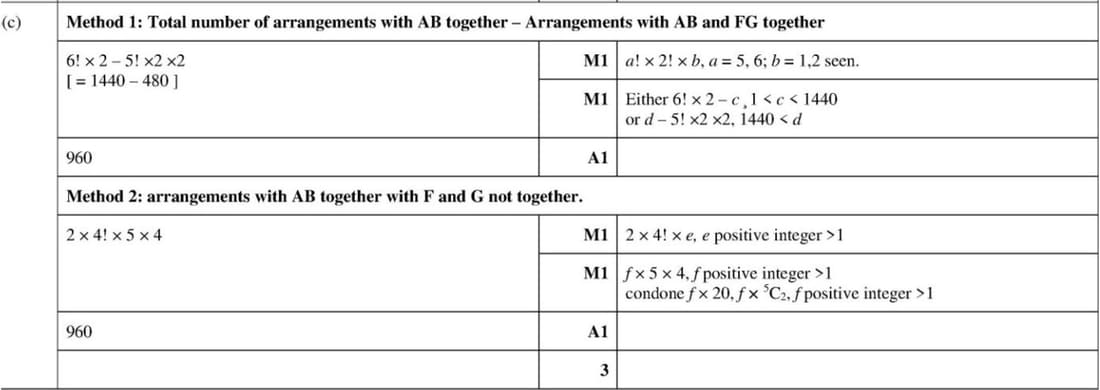
Consider Abel and Betty as a single unit or block. This reduces the problem to arranging 6 units: (AB), Cally, Doug, Eve, Freya, and Gino.
The number of ways to arrange these 6 units is given by:
\(6! = 720\)
Within the block (AB), Abel and Betty can be arranged in:
\(2! = 2\)
Thus, the total number of arrangements with Abel and Betty together is:
\(6! \times 2! = 720 \times 2 = 1440\)
Now, consider the arrangements where Freya and Gino are also together. Treat Freya and Gino as another block, reducing the problem to arranging 5 units: (AB), (FG), Cally, Doug, and Eve.
The number of ways to arrange these 5 units is:
\(5! = 120\)
Within the block (FG), Freya and Gino can be arranged in:
\(2! = 2\)
Thus, the total number of arrangements with both (AB) and (FG) together is:
\(5! \times 2! \times 2! = 120 \times 2 \times 2 = 480\)
Therefore, the number of arrangements where Abel and Betty are together but Freya and Gino are not together is:
\(1440 - 480 = 960\)