Browsing as Guest. Progress, bookmarks and attempts are disabled.
Log in to track your work.
Nov 2013 p61 q6
2785
A shop has 7 different mountain bicycles, 5 different racing bicycles and 8 different ordinary bicycles on display. A cycling club selects 6 of these 20 bicycles to buy.
The cycling club buys 3 mountain bicycles, 1 racing bicycle and 2 ordinary bicycles and parks them in a cycle rack, which has a row of 10 empty spaces.
(ii) How many different arrangements are there in the cycle rack if the mountain bicycles are all together with no spaces between them, the ordinary bicycles are both together with no spaces between them and the spaces are all together?
(iii) How many different arrangements are there in the cycle rack if the ordinary bicycles are at each end of the bicycles and there are no spaces between any of the bicycles?
Solution
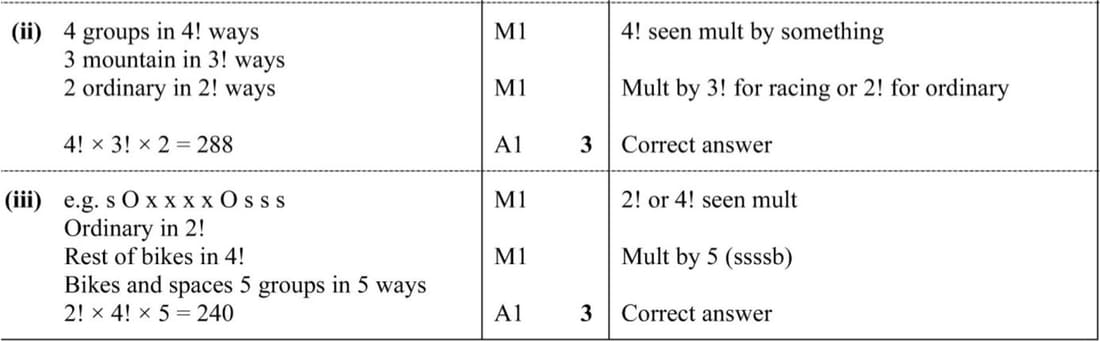
(ii) Consider the groups: mountain bicycles, racing bicycle, ordinary bicycles, and spaces. There are 4 groups to arrange, which can be done in \(4!\) ways. The mountain bicycles can be arranged among themselves in \(3!\) ways, and the ordinary bicycles can be arranged in \(2!\) ways. Therefore, the total number of arrangements is \(4! \times 3! \times 2 = 288\).
(iii) The ordinary bicycles are at each end, so they can be arranged in \(2!\) ways. The remaining bicycles (3 mountain and 1 racing) can be arranged in \(4!\) ways. The spaces and bicycles form 5 groups, which can be arranged in \(5!\) ways. Therefore, the total number of arrangements is \(2! \times 4! \times 5 = 240\).