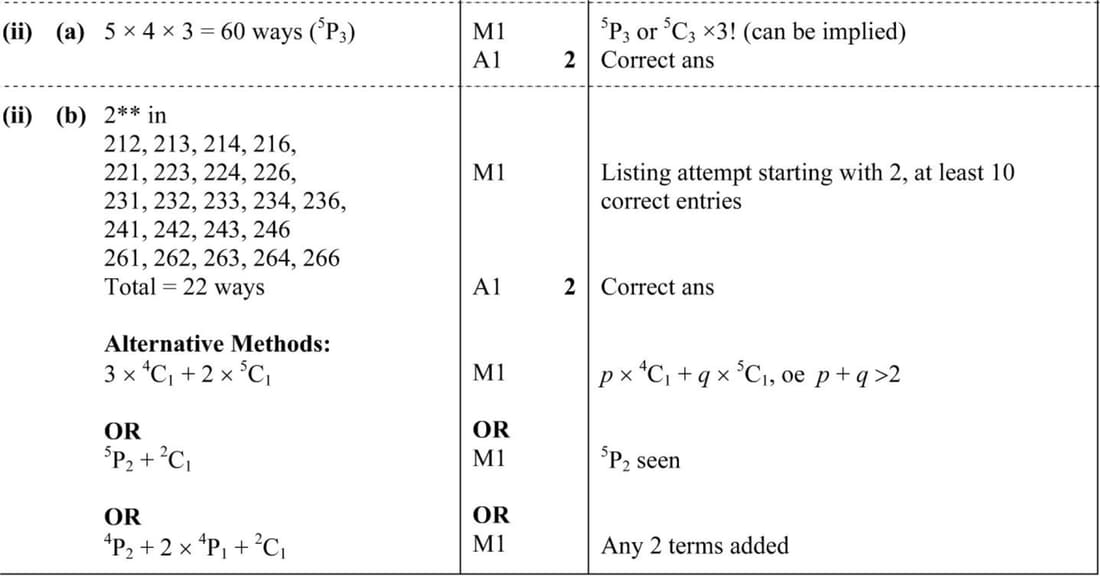
(a) To form a 3-digit number with no repeated digits, we choose 3 different digits from the available numbers: 1, 2, 3, 4, 6. There are 5 different digits, so we calculate the permutations of choosing 3 out of 5:
\(^5P_3 = \frac{5!}{(5-3)!} = 5 \times 4 \times 3 = 60\)
Thus, there are 60 different numbers that can be made with no repeated digits.
(b) To form a number between 200 and 300, the first digit must be 2. The remaining two digits can be chosen from 1, 2, 3, 3, 4, 6, 6, 6. We list the possible numbers:
212, 213, 214, 216, 221, 223, 224, 226, 231, 232, 233, 234, 236, 241, 242, 243, 246, 261, 262, 263, 264, 266
There are 22 such numbers.