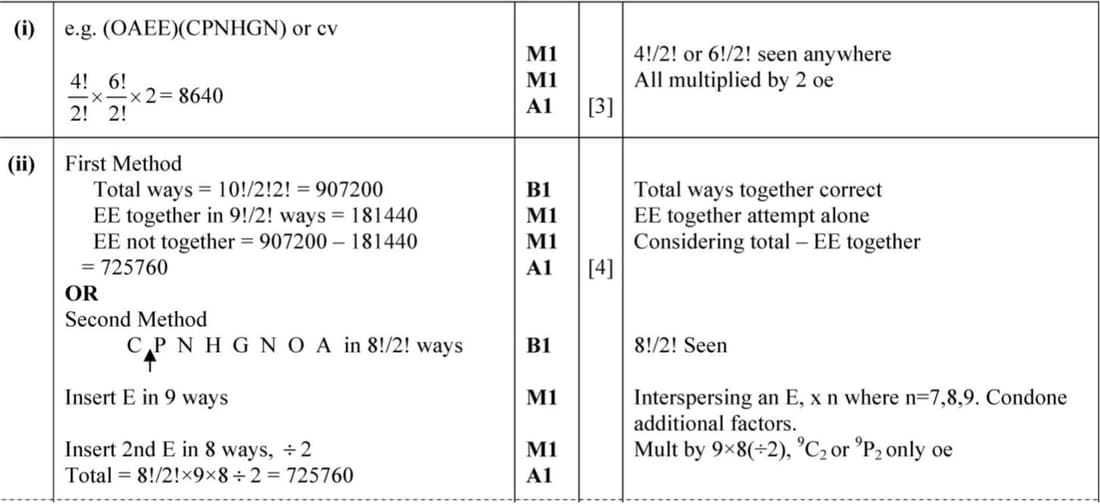
(i) Consider the vowels (A, E, O) as a single unit and the consonants (C, G, H, N, P) as another unit. This gives us two units: (OAEE) and (CPNHGN). The arrangement of these two units can be done in 2! ways.
Within the vowels, A, E, and O can be arranged in 4!/2! ways because there are two Es.
Within the consonants, C, G, H, N, and P can be arranged in 6!/2! ways because there are two Ns.
Thus, the total number of arrangements is:
\(2! \times \frac{4!}{2!} \times \frac{6!}{2!} = 2 \times 12 \times 360 = 8640\)
(ii) First, calculate the total number of arrangements of the letters in COPENHAGEN without any restrictions. This is given by:
\(\frac{10!}{2!2!} = 907200\)
Next, calculate the number of arrangements where the two Es are together. Treat the two Es as a single unit, reducing the problem to arranging 9 units (including the double E) with the repeated N:
\(\frac{9!}{2!} = 181440\)
Subtract the number of arrangements where the Es are together from the total arrangements to find the number where the Es are not together:
\(907200 - 181440 = 725760\)
Alternatively, consider arranging the letters C, P, N, H, G, N, O, A in \(\frac{8!}{2!}\) ways, then insert the first E in 9 possible positions and the second E in 8 possible positions, dividing by 2 to account for the indistinguishable Es:
\(\frac{8!}{2!} \times 9 \times 8 \div 2 = 725760\)