Problem #2657
Metadata not filled yet
2657
Last Saturday, Sarah recorded the colour and type of 160 cars in a car park. All the cars that were not red or silver in colour were grouped together as 'other'. Her results are shown in the following table.
| Colour of car | Saloon | Hatchback | Estate |
|---|---|---|---|
| Red | 20 | 40 | 12 |
| Silver | 14 | 26 | 10 |
| Other | 6 | 24 | 8 |
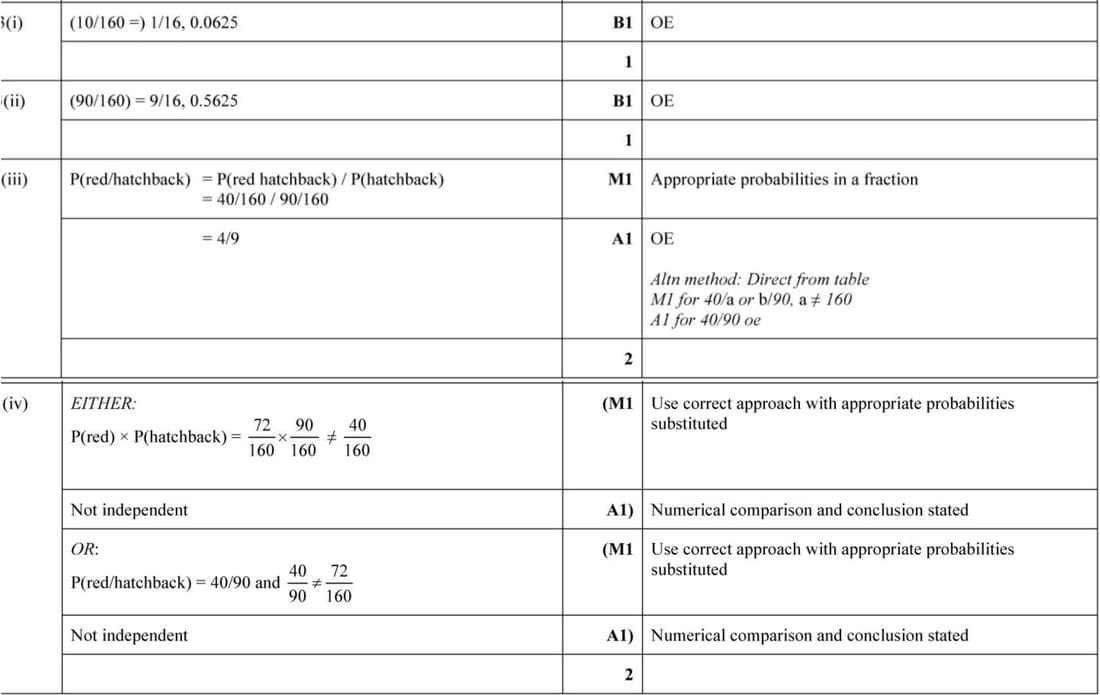
- Find the probability that a randomly chosen car in the car park is a silver estate car. [1]
- Find the probability that a randomly chosen car in the car park is a hatchback car. [1]
- Find the probability that a randomly chosen car in the car park is red, given that it is a hatchback car. [2]
- One of the cars in the car park is chosen at random. Determine whether the events 'the car is a hatchback car' and 'the car is red' are independent, justifying your answer. [2]