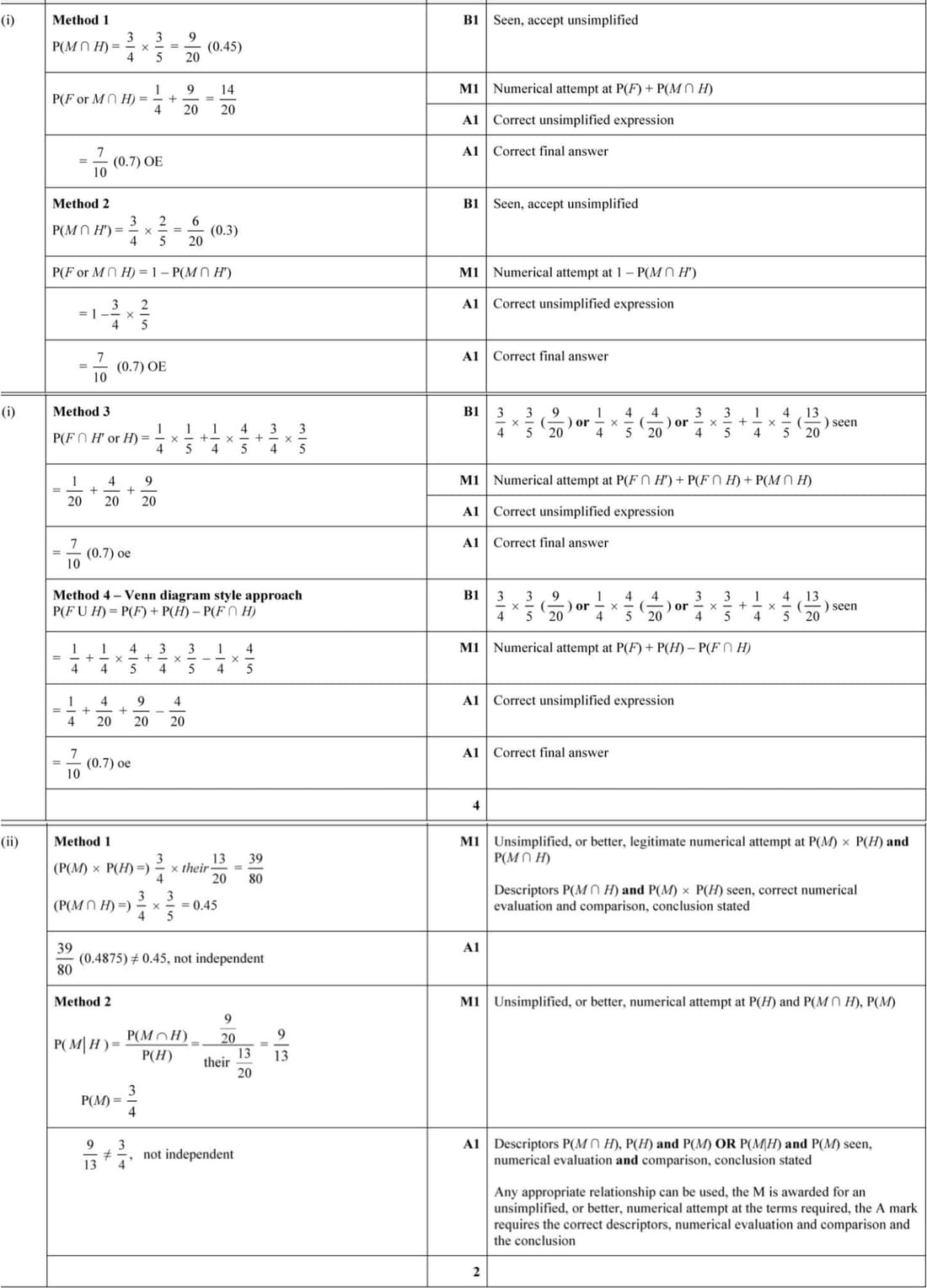
(i) Let \(M\) be the event that a student is male, \(F\) be the event that a student is female, and \(H\) be the event that a student likes their curry hot.
We have \(P(M) = \frac{3}{4}\) and \(P(F) = \frac{1}{4}\).
The probability that a male student likes their curry hot is \(P(H|M) = \frac{3}{5}\), so \(P(M \cap H) = P(M) \cdot P(H|M) = \frac{3}{4} \cdot \frac{3}{5} = \frac{9}{20}\).
The probability that a female student likes their curry hot is \(P(H|F) = \frac{4}{5}\), so \(P(F \cap H) = P(F) \cdot P(H|F) = \frac{1}{4} \cdot \frac{4}{5} = \frac{1}{5} = \frac{4}{20}\).
The probability that a student likes their curry hot is \(P(H) = P(M \cap H) + P(F \cap H) = \frac{9}{20} + \frac{4}{20} = \frac{13}{20}\).
The probability that the student is either female, or likes their curry hot, or both is \(P(F \cup H) = P(F) + P(H) - P(F \cap H) = \frac{1}{4} + \frac{13}{20} - \frac{4}{20} = \frac{5}{20} + \frac{13}{20} - \frac{4}{20} = \frac{14}{20} = \frac{7}{10}\).
(ii) To determine independence, check if \(P(M \cap H) = P(M) \cdot P(H)\).
We have \(P(M \cap H) = \frac{9}{20}\) and \(P(M) \cdot P(H) = \frac{3}{4} \cdot \frac{13}{20} = \frac{39}{80}\).
Since \(\frac{9}{20} \neq \frac{39}{80}\), the events are not independent.