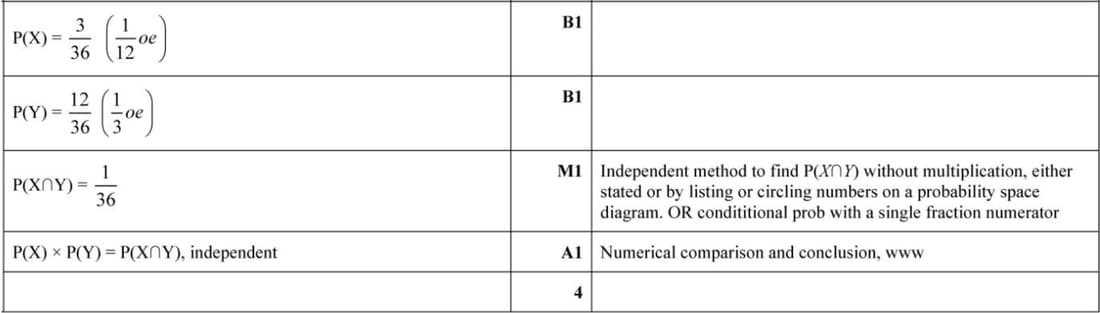
To determine if events X and Y are independent, we need to check if \(P(X \cap Y) = P(X) \times P(Y)\).
First, calculate \(P(X)\):
The possible outcomes for the total score to be 4 are (1,3), (2,2), and (3,1). Thus, there are 3 favorable outcomes.
Since there are 36 possible outcomes when a die is thrown twice, \(P(X) = \frac{3}{36}\).
Next, calculate \(P(Y)\):
The first score can be 2 or 5. For each of these, there are 6 possible outcomes for the second die. Thus, there are 12 favorable outcomes.
So, \(P(Y) = \frac{12}{36}\).
Now, calculate \(P(X \cap Y)\):
The outcomes that satisfy both X and Y are (2,2). Thus, there is 1 favorable outcome.
So, \(P(X \cap Y) = \frac{1}{36}\).
Check for independence:
\(P(X) \times P(Y) = \frac{3}{36} \times \frac{12}{36} = \frac{1}{36}\).
Since \(P(X \cap Y) = P(X) \times P(Y)\), events X and Y are independent.