Browsing as Guest. Progress, bookmarks and attempts are disabled.
Log in to track your work.
June 2004 p6 q2
2481
In a recent survey, 640 people were asked about the length of time each week that they spent watching television. The median time was found to be 20 hours, and the lower and upper quartiles were 15 hours and 35 hours respectively. The least amount of time that anyone spent was 3 hours, and the greatest amount was 60 hours.
On graph paper, show these results using a fully labelled cumulative frequency graph.
Use your graph to estimate how many people watched more than 50 hours of television each week.
Solution
To construct the cumulative frequency graph, plot the following points based on the given data:
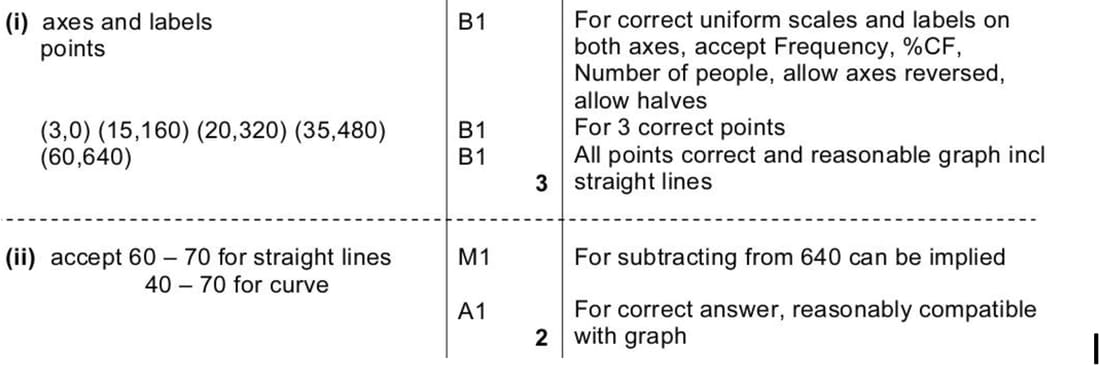
(3, 0) - The least amount of time spent is 3 hours, so cumulative frequency starts at 0.
(15, 160) - The lower quartile is 15 hours, so 25% of 640 people is 160.
(20, 320) - The median is 20 hours, so 50% of 640 people is 320.
(35, 480) - The upper quartile is 35 hours, so 75% of 640 people is 480.
(60, 640) - The greatest amount of time spent is 60 hours, so cumulative frequency is 640.
Draw a smooth curve or straight lines connecting these points to form the cumulative frequency graph.
To estimate how many people watched more than 50 hours of television, find the cumulative frequency at 50 hours on the graph and subtract from 640. The mark scheme suggests an estimate of 60 to 70 people.