9709 P63 - Nov 2016 - Q5
2467
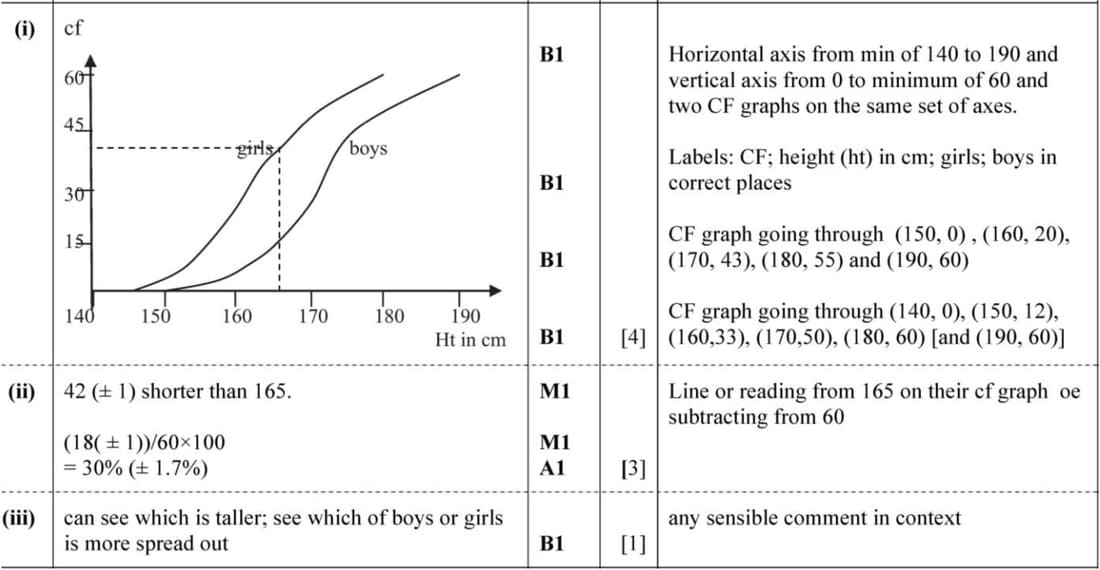
The tables summarise the heights, \(h\) (cm), of 60 girls and 60 boys.
| Height of girls (cm) | \(140 < h \le 150\) | \(150 < h \le 160\) | \(160 < h \le 170\) | \(170 < h \le 180\) | \(180 < h \le 190\) |
|---|---|---|---|---|---|
| Frequency | 12 | 21 | 17 | 10 | 0 |
| Height of boys (cm) | \(140 < h \le 150\) | \(150 < h \le 160\) | \(160 < h \le 170\) | \(170 < h \le 180\) | \(180 < h \le 190\) |
|---|---|---|---|---|---|
| Frequency | 0 | 20 | 23 | 12 | 5 |
- On graph paper, using the same axes, draw two cumulative frequency graphs to illustrate the data.
- The cave on the school trip is \(165\ \text{cm}\) high. Use your graph to estimate the percentage of girls who will be unable to stand upright.
- State one advantage of using a pair of box-and-whisker plots rather than cumulative frequency graphs to compare the heights of the girls and the boys.