Browsing as Guest. Progress, bookmarks and attempts are disabled.
Log in to track your work.
9709 P51 - Nov 2023 - Q1
2466
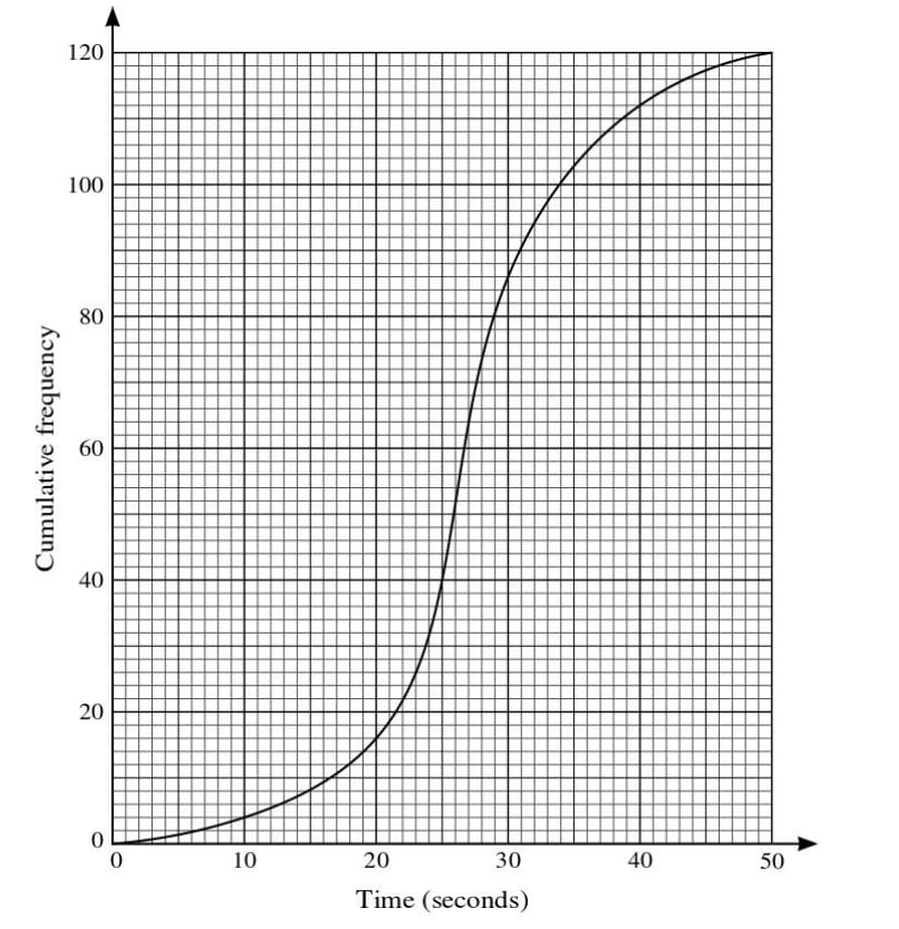
The times taken by 120 children to complete a particular puzzle are represented in the cumulative frequency graph.
(a) Use the graph to estimate the interquartile range of the data.
35% of the children took longer than \(T\) seconds to complete the puzzle.
(b) Use the graph to estimate the value of \(T\).
Solution
(a) To find the interquartile range (IQR), we need to determine the values of the lower quartile (\(Q_1\)) and the upper quartile (\(Q_3\)).
\(Q_1\) is at the 25th percentile, which corresponds to \(0.25 \times 120 = 30\) on the cumulative frequency axis. From the graph, \(Q_1 \approx 23.7\) seconds.
\(Q_3\) is at the 75th percentile, which corresponds to \(0.75 \times 120 = 90\) on the cumulative frequency axis. From the graph, \(Q_3 \approx 31\) seconds.
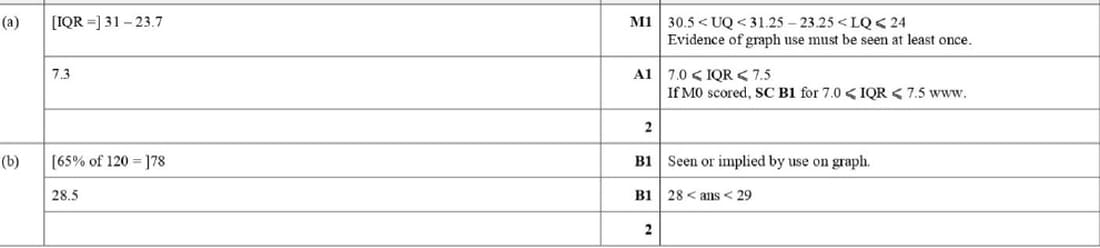
Thus, the interquartile range is \(Q_3 - Q_1 = 31 - 23.7 = 7.3\) seconds.
(b) To find \(T\), note that 35% of the children took longer than \(T\) seconds. This means 65% took \(T\) seconds or less.
65% of 120 children is \(0.65 \times 120 = 78\).
From the graph, the time corresponding to a cumulative frequency of 78 is approximately \(28.5\) seconds.