June 2017 p63 q7
2464
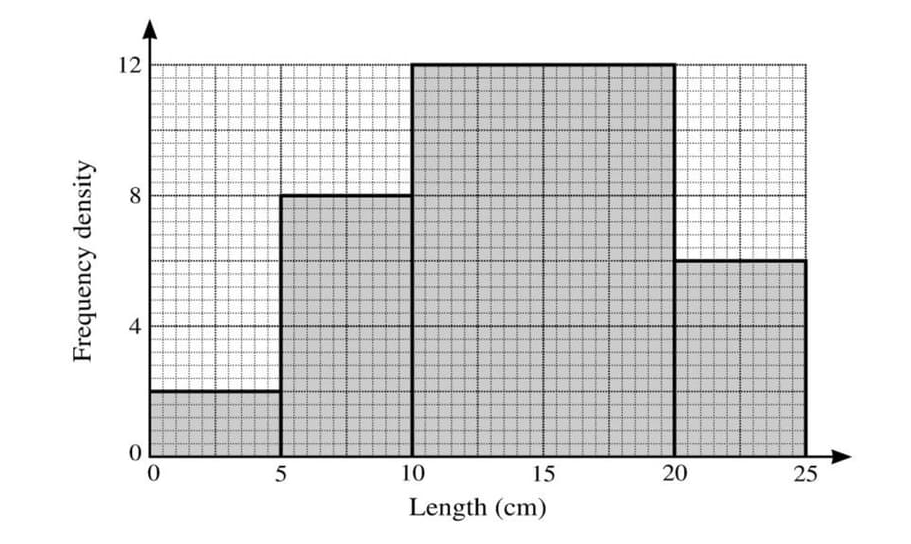
The following histogram represents the lengths of worms in a garden.
(i) Calculate the frequencies represented by each of the four histogram columns.
(ii) On the grid on the next page, draw a cumulative frequency graph to represent the lengths of worms in the garden.
(iii) Use your graph to estimate the median and interquartile range of the lengths of worms in the garden.
(iv) Calculate an estimate of the mean length of worms in the garden.
Solution
(i) The frequency for each class is calculated by multiplying the frequency density by the class width:
- For length 0-5 cm: Frequency density = 2, Class width = 5, Frequency = 2 ร 5 = 10
- For length 5-10 cm: Frequency density = 8, Class width = 5, Frequency = 8 ร 5 = 40
- For length 10-20 cm: Frequency density = 12, Class width = 10, Frequency = 12 ร 10 = 120
- For length 20-25 cm: Frequency density = 6, Class width = 5, Frequency = 6 ร 5 = 30
(ii) Cumulative frequencies are calculated as follows:
- Length < 5 cm: Cumulative frequency = 10
- Length < 10 cm: Cumulative frequency = 10 + 40 = 50
- Length < 20 cm: Cumulative frequency = 50 + 120 = 170
- Length < 25 cm: Cumulative frequency = 170 + 30 = 200
Plot these cumulative frequencies against the upper class boundaries to draw the cumulative frequency graph.
(iii) From the cumulative frequency graph:
- Median is the value at the 100th position (half of 200), which is approximately 14.2 cm.
- Lower quartile (LQ) is the value at the 50th position, approximately 10 cm.
- Upper quartile (UQ) is the value at the 150th position, approximately 18.5 cm.
- Interquartile range (IQR) = UQ - LQ = 18.5 - 10 = 8.5 cm.
(iv) Estimate the mean using midpoints and frequencies:
- Mean = \(\frac{(2.5 \times 10) + (7.5 \times 40) + (15 \times 120) + (22.5 \times 30)}{200}\)
- Mean = \(\frac{25 + 300 + 1800 + 675}{200} = \frac{2800}{200} = 14\)
Log in to record attempts.