Browsing as Guest. Progress, bookmarks and attempts are disabled.
Log in to track your work.
Nov 2017 p62 q2
2462
The circumferences, \(c\) cm, of some trees in a wood were measured. The results are summarised in the table.
Circumference (c cm)
\(40 < c \leq 50\)
\(50 < c \leq 80\)
\(80 < c \leq 100\)
\(100 < c \leq 120\)
Frequency
14
48
70
8
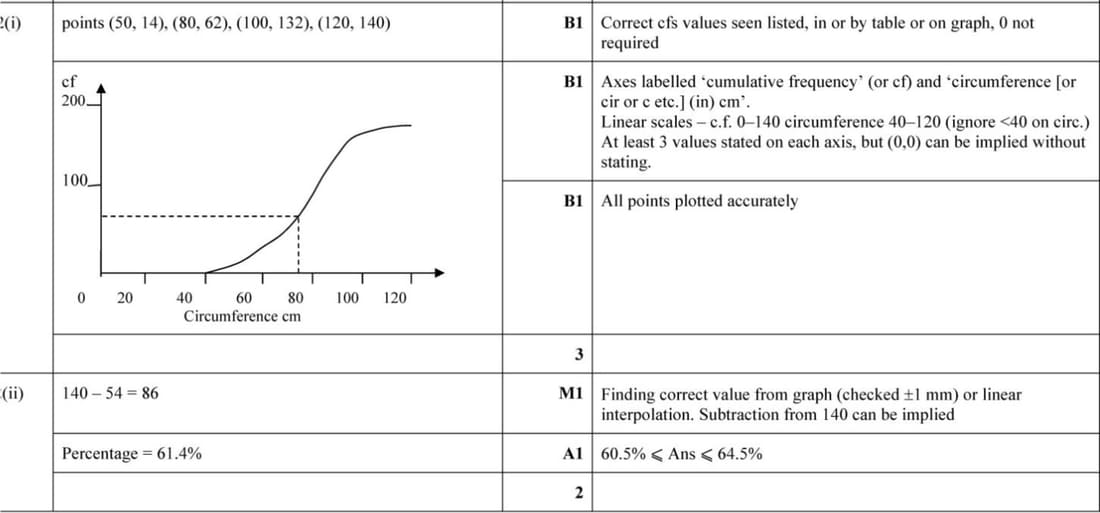
(i) On the grid, draw a cumulative frequency graph to represent the information.
(ii) Estimate the percentage of trees which have a circumference larger than 75 cm.
Solution
To solve this problem, we first need to construct the cumulative frequency table from the given frequency distribution:
Circumference (c cm)
Cumulative Frequency
\(c \leq 50\)
14
\(c \leq 80\)
62
\(c \leq 100\)
132
\(c \leq 120\)
140
(i) Plot these cumulative frequencies against the upper class boundaries on the grid to draw the cumulative frequency graph.
(ii) To estimate the percentage of trees with circumference larger than 75 cm, we need to find the cumulative frequency at 75 cm. Using linear interpolation between 50 cm and 80 cm:
Cumulative frequency at 75 cm =\( 14 + \frac{75 - 50}{80 - 50} \times (62 - 14) = 54\)
The total number of trees is 140. The number of trees with circumference larger than 75 cm is: