Browsing as Guest. Progress, bookmarks and attempts are disabled.
Log in to track your work.
Nov 2019 p61 q5
2457
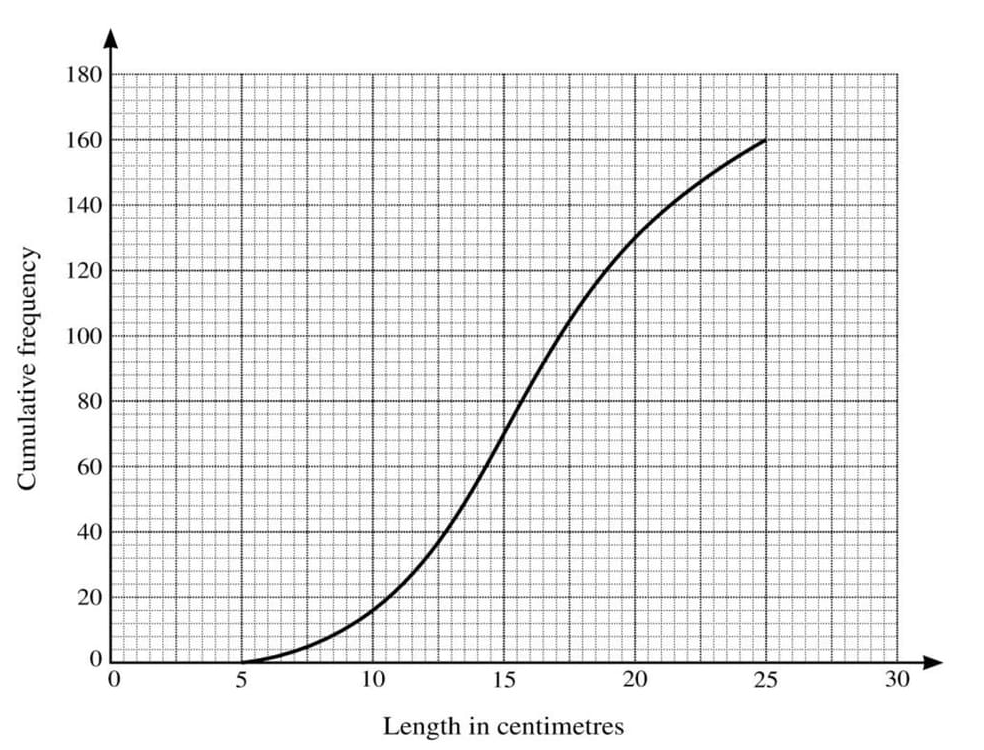
Ransha measured the lengths, in centimetres, of 160 palm leaves. His results are illustrated in the cumulative frequency graph below.
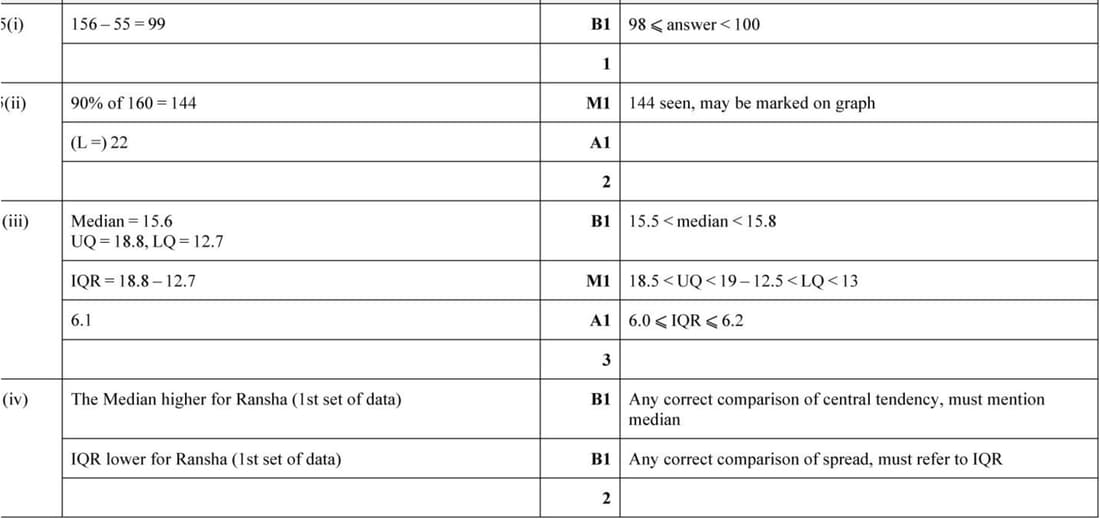
(i) Estimate how many leaves have a length between 14 and 24 centimetres.
(ii) 10% of the leaves have a length of \(L\) centimetres or more. Estimate the value of \(L\).
(iii) Estimate the median and the interquartile range of the lengths.
Sharim measured the lengths, in centimetres, of 160 palm leaves of a different type. He drew a box-and-whisker plot for the data, as shown on the grid below.
(iv) Compare the central tendency and the spread of the two sets of data.
Solution
(i) From the cumulative frequency graph, the cumulative frequency at 14 cm is approximately 55, and at 24 cm is approximately 156. Therefore, the number of leaves between 14 and 24 cm is \(156 - 55 = 101\).
(ii) 10% of 160 leaves is 16 leaves. Therefore, 144 leaves have a length less than \(L\). From the graph, \(L\) corresponds to a cumulative frequency of 144, which is approximately 22 cm.
(iii) The median is at the 80th leaf (\(\frac{160}{2}\)), which corresponds to approximately 15.6 cm on the graph. The lower quartile \(Q_1\) is at the 40th leaf, approximately 12.7 cm, and the upper quartile \(Q_3\) is at the 120th leaf, approximately 18.8 cm. The interquartile range is \(Q_3 - Q_1 = 18.8 - 12.7 = 6.1\).
(iv) The median for Ransha's data is higher than Sharim's data. The interquartile range for Ransha's data is lower than Sharim's data, indicating less spread.