Browsing as Guest. Progress, bookmarks and attempts are disabled.
Log in to track your work.
Nov 2012 p62 q3
2404
The table summarises the times that 112 people took to travel to work on a particular day.
Time (minutes)
0 < t ≤ 10
10 < t ≤ 15
15 < t ≤ 20
20 < t ≤ 25
25 < t ≤ 40
40 < t ≤ 60
Frequency
19
12
28
22
18
13
State which time interval in the table contains the median and which time interval contains the upper quartile.
On graph paper, draw a histogram to represent the data.
Calculate an estimate of the mean time to travel to work.
Solution
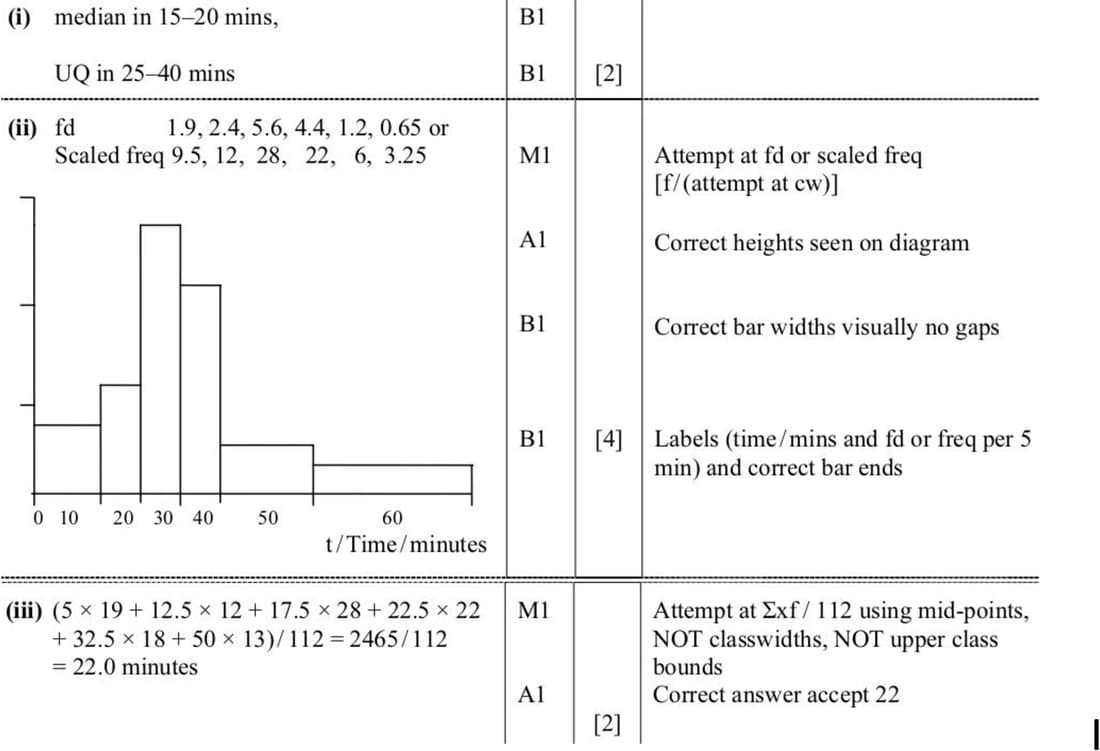
(i) To find the median, calculate the cumulative frequency to find the middle value. The cumulative frequencies are: 19, 31, 59, 81, 99, 112. The median is the 56th value, which falls in the 15 < t ≤ 20 interval. The upper quartile (UQ) is the 84th value, which falls in the 25 < t ≤ 40 interval.
(ii) To draw the histogram, calculate the frequency density for each interval:
0 < t ≤ 10: fd = 19/10 = 1.9
10 < t ≤ 15: fd = 12/5 = 2.4
15 < t ≤ 20: fd = 28/5 = 5.6
20 < t ≤ 25: fd = 22/5 = 4.4
25 < t ≤ 40: fd = 18/15 = 1.2
40 < t ≤ 60: fd = 13/20 = 0.65
Draw bars with these heights and corresponding widths.
(iii) To estimate the mean, use the midpoints of each interval: