June 2014 p62 q6
2398
The times taken by 57 athletes to run 100 metres are summarised in the following cumulative frequency table.
| Time (seconds) |
<10.0 |
<10.5 |
<11.0 |
<12.0 |
<12.5 |
<13.5 |
| Cumulative frequency |
0 |
4 |
10 |
40 |
49 |
57 |
- State how many athletes ran 100 metres in a time between 10.5 and 11.0 seconds.
- Draw a histogram on graph paper to represent the times taken by these athletes to run 100 metres.
- Calculate estimates of the mean and variance of the times taken by these athletes.
Solution
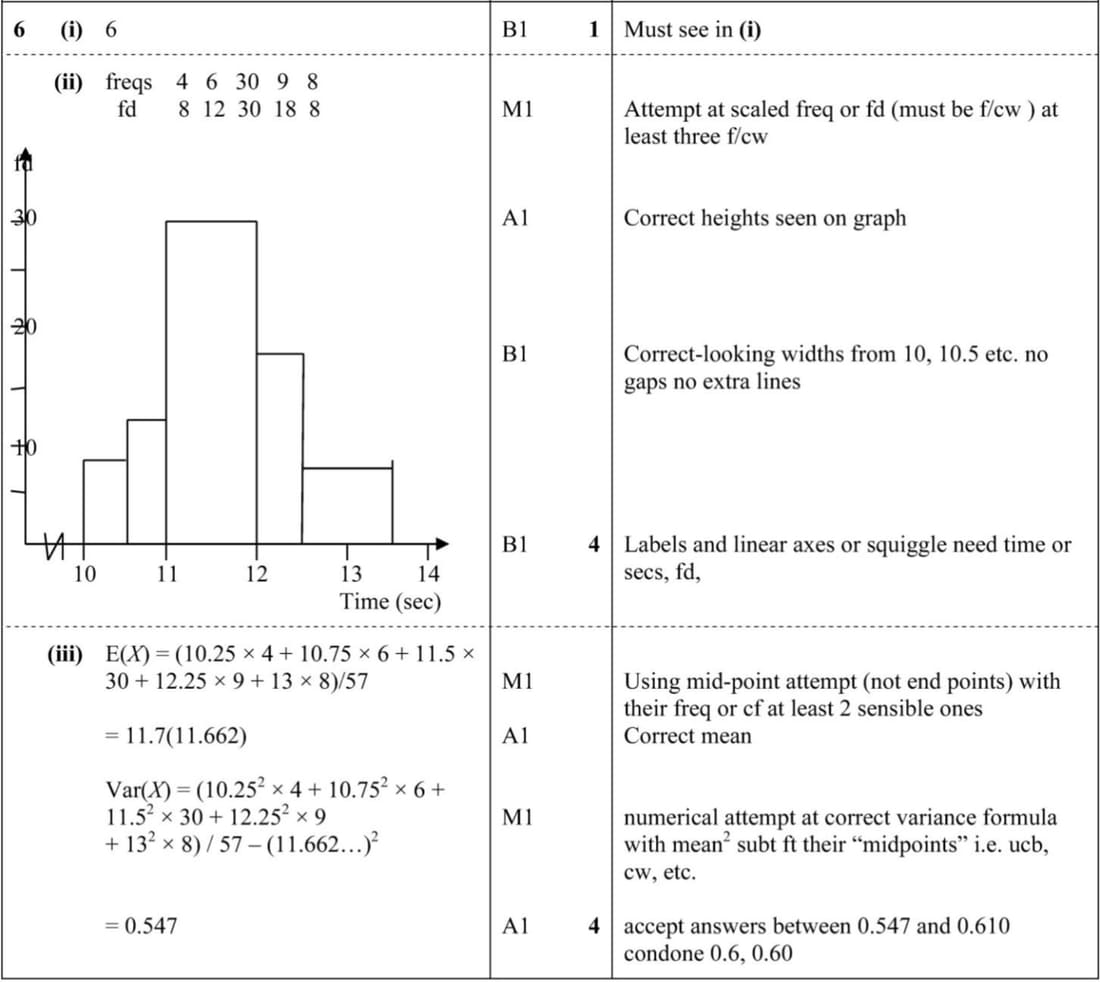
(i) The number of athletes who ran between 10.5 and 11.0 seconds is the difference in cumulative frequencies:
\(10 - 4 = 6.\)
(ii) To draw the histogram, calculate the frequency for each interval:
- 10.0 to 10.5: 4 athletes
- 10.5 to 11.0: 6 athletes
- 11.0 to 12.0: 30 athletes
- 12.0 to 12.5: 9 athletes
- 12.5 to 13.5: 8 athletes
Use these frequencies to draw the histogram with appropriate widths and heights.
(iii) Calculate the mean using midpoints:
\(E(X) = \frac{(10.25 \times 4) + (10.75 \times 6) + (11.5 \times 30) + (12.25 \times 9) + (13 \times 8)}{57} = 11.7\)
Calculate the variance:
\(\text{Var}(X) = \frac{(10.25^2 \times 4) + (10.75^2 \times 6) + (11.5^2 \times 30) + (12.25^2 \times 9) + (13^2 \times 8)}{57} - (11.7)^2 = 0.547\)
Log in to record attempts.