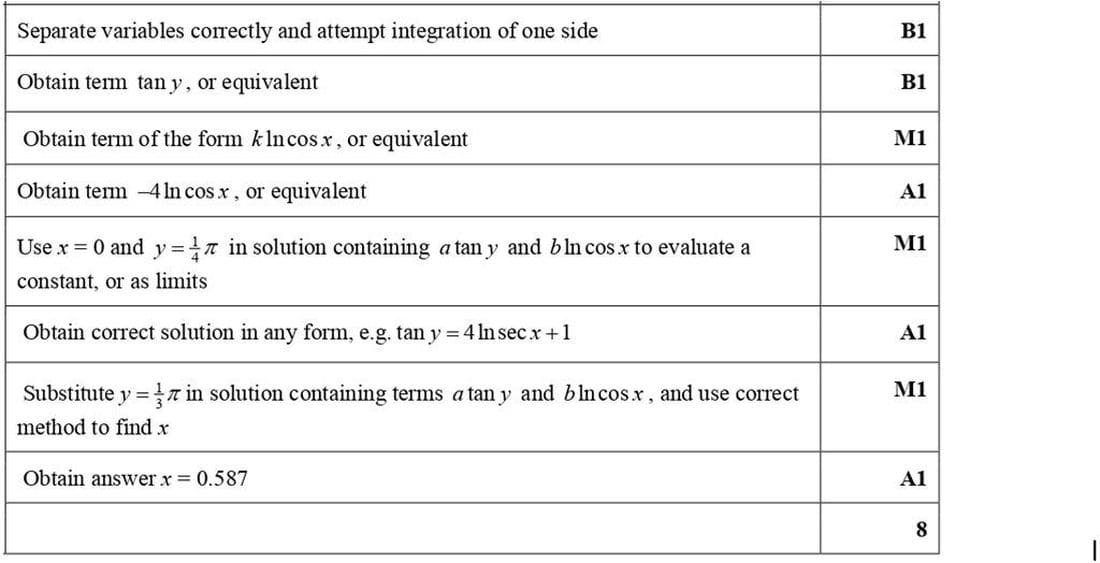
Separate the variables: \(\frac{1}{\cos^2 y} dy = 4 \tan x \, dx\).
Integrate both sides: \(\int \sec^2 y \, dy = \int 4 \tan x \, dx\).
The integrals are: \(\tan y = 4 \ln |\sec x| + C\).
Use the initial condition \(x = 0\) and \(y = \frac{1}{4}\pi\):
\(\tan \left( \frac{1}{4}\pi \right) = 4 \ln |\sec 0| + C\).
\(1 = 4 \cdot 0 + C \Rightarrow C = 1\).
The solution is \(\tan y = 4 \ln |\sec x| + 1\).
Substitute \(y = \frac{1}{3}\pi\):
\(\tan \left( \frac{1}{3}\pi \right) = 4 \ln |\sec x| + 1\).
\(\sqrt{3} = 4 \ln |\sec x| + 1\).
\(4 \ln |\sec x| = \sqrt{3} - 1\).
\(\ln |\sec x| = \frac{\sqrt{3} - 1}{4}\).
\(|\sec x| = e^{\frac{\sqrt{3} - 1}{4}}\).
\(\sec x = e^{\frac{\sqrt{3} - 1}{4}}\).
\(x = \arccos \left( \frac{1}{e^{\frac{\sqrt{3} - 1}{4}}} \right)\).
\(x \approx 0.587\).