Browsing as Guest. Progress, bookmarks and attempts are disabled.
Log in to track your work.
June 2020 p33 q10
2316
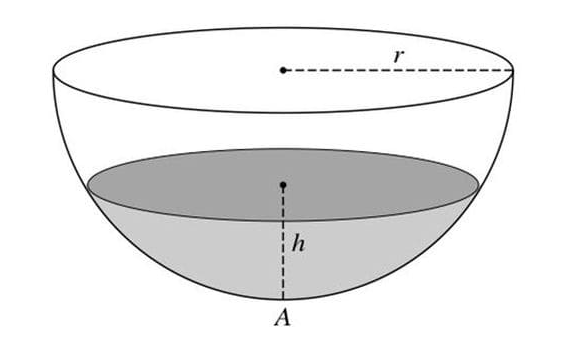
A tank containing water is in the form of a hemisphere. The axis is vertical, the lowest point is A and the radius is r, as shown in the diagram. The depth of water at time t is h. At time t = 0 the tank is full and the depth of the water is r. At this instant a tap at A is opened and water begins to flow out at a rate proportional to \(\sqrt{h}\). The tank becomes empty at time t = 14.
The volume of water in the tank is V when the depth is h. It is given that \(V = \frac{1}{3} \pi (3rh^2 - h^3)\).
(a) Show that h and t satisfy a differential equation of the form \(\frac{dh}{dt} = -\frac{B}{2rh^2 - h^3}\)
where B is a positive constant.
(b) Solve the differential equation and obtain an expression for t in terms of h and r.
Solution
(a) The rate of change of volume is given by \(\frac{dV}{dt} = -k\sqrt{h}\). The volume of the hemisphere is \(V = \frac{1}{3} \pi (3rh^2 - h^3)\). Differentiating with respect to h, \(\frac{dV}{dh} = 2\pi rh - \pi h^2\).
Using the chain rule, \(\frac{dV}{dt} = \frac{dV}{dh} \cdot \frac{dh}{dt}\), we have \(-k\sqrt{h} = (2\pi rh - \pi h^2) \cdot \frac{dh}{dt}\).
Rearranging gives \(\frac{dh}{dt} = -\frac{k\sqrt{h}}{2\pi rh - \pi h^2}\). Let \(B = k\pi\), then \(\frac{dh}{dt} = -\frac{B}{2rh^2 - h^3}\).
(b) Separate variables: \((2rh^2 - h^3) dh = -B dt\). Integrate both sides: \(\int (2rh^2 - h^3) dh = -\int B dt\).
The left side integrates to \(\frac{2}{3}rh^3 - \frac{1}{4}h^4\) and the right side to \(-Bt + C\).
At \(t = 0, h = r\), so \(\frac{2}{3}r^4 - \frac{1}{4}r^4 = C\).
At \(t = 14, h = 0\), so \(0 = -14B + C\).
Solving these gives \(C = \frac{5}{12}r^4\) and \(B = \frac{1}{15}r^2\).
Substitute back to find \(t\): \(t = 14 - 20\left(\frac{h}{r}\right)^{\frac{3}{2}} + 6\left(\frac{h}{r}\right)^{\frac{5}{2}}\).