9709 P3 - Jun 2008 - Q8
2310
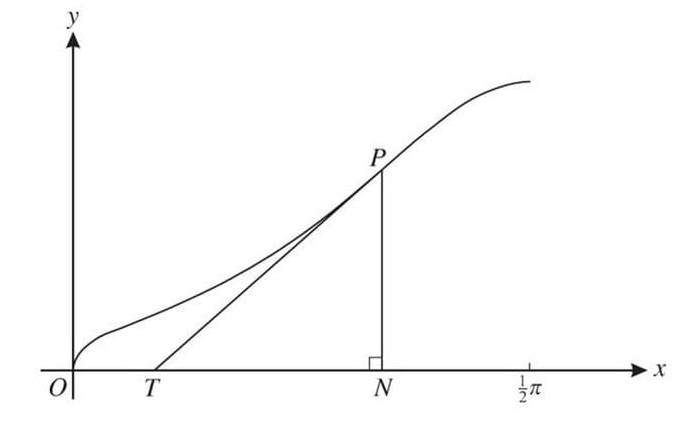
In the diagram the tangent to a curve at a general point \(P\) with coordinates \((x, y)\) meets the \(x\)-axis at \(T\). The point \(N\) on the \(x\)-axis is such that \(PN\) is perpendicular to the \(x\)-axis. The curve is such that, for all values of \(x\) in the interval \(0 < x < \frac{1}{2}\pi\), the area of triangle \(PTN\) is equal to \(\tan x\), where \(x\) is in radians.
(i) Using the fact that the gradient of the curve at \(P\) is \(\frac{PN}{TN}\), show that \(\frac{dy}{dx} = \frac{1}{2}y^2 \cot x\).
(ii) Given that \(y = 2\) when \(x = \frac{1}{6}\pi\), solve this differential equation to find the equation of the curve, expressing \(y\) in terms of \(x\).
Solutions locked. Please sign in with access to view them.