9709 P3 - Nov 2008 - Q8
2309
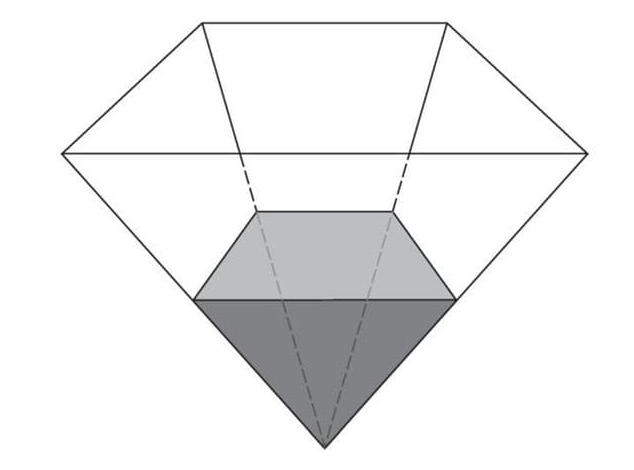
An underground storage tank is being filled with liquid as shown in the diagram. Initially the tank is empty. At time \(t\) hours after filling begins, the volume of liquid is \(V\) m\(^3\) and the depth of liquid is \(h\) m. It is given that \(V = \frac{4}{3}h^3\).
The liquid is poured in at a rate of 20 m\(^3\) per hour, but owing to leakage, liquid is lost at a rate proportional to \(h^2\). When \(h = 1\), \(\frac{dh}{dt} = 4.95\).
- Show that \(h\) satisfies the differential equation \(\frac{dh}{dt} = \frac{5}{h^2} - \frac{1}{20}\).
- Verify that \(\frac{20h^2}{100-h^2} = -20 + \frac{2000}{(10-h)(10+h)}\).
- Hence solve the differential equation in part (i), obtaining an expression for \(t\) in terms of \(h\).
Solutions locked. Please sign in with access to view them.