9709 P31 - Nov 2009 - Q10
2308
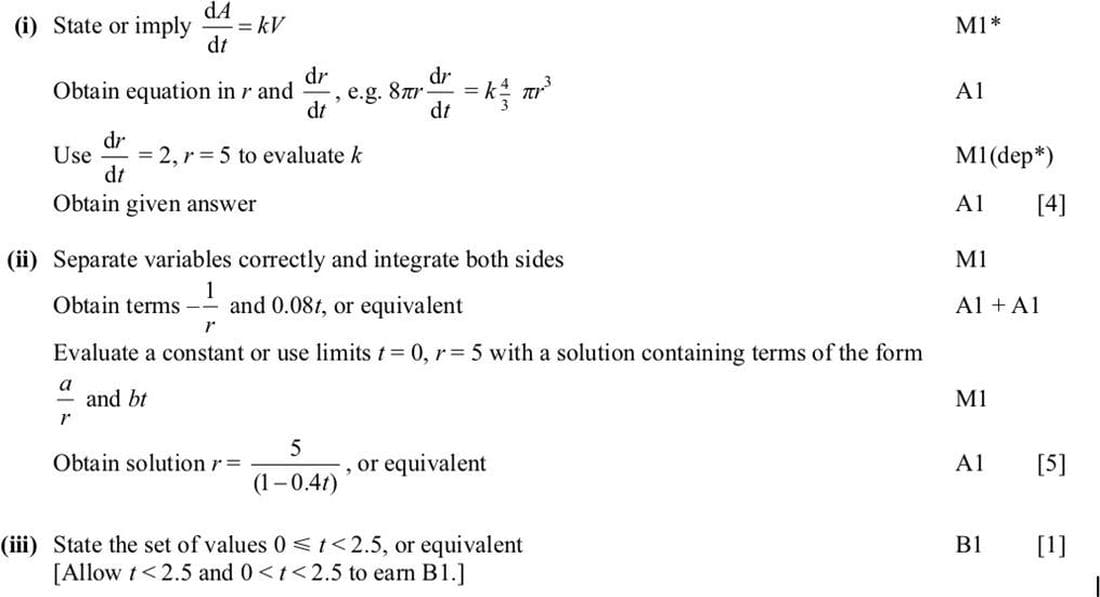
In a model of the expansion of a sphere of radius r cm, it is assumed that, at time t seconds after the start, the rate of increase of the surface area of the sphere is proportional to its volume. When t = 0, r = 5 and \(\frac{dr}{dt} = 2\).
(i) Show that r satisfies the differential equation \(\frac{dr}{dt} = 0.08r^2\).
[The surface area A and volume V of a sphere of radius r are given by the formulae \(A = 4\pi r^2\), \(V = \frac{4}{3}\pi r^3\).]
(ii) Solve this differential equation, obtaining an expression for r in terms of t.
(iii) Deduce from your answer to part (ii) the set of values that t can take, according to this model.