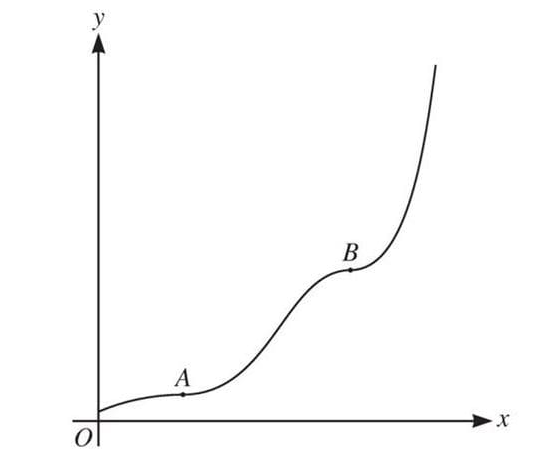
To solve the differential equation \(3y^2 \frac{dy}{dx} = 4(y^3 + 1) \cos^2 x\), we first use the identity \(\cos^2 x = \frac{1 + \cos 2x}{2}\) to rewrite the equation as:
\(3y^2 \frac{dy}{dx} = 2(y^3 + 1)(1 + \cos 2x)\).
Separate variables and integrate:
\(\int \frac{3y^2}{y^3 + 1} \, dy = \int 2(1 + \cos 2x) \, dx\).
The left side integrates to \(\ln(y^3 + 1)\), and the right side integrates to \(2x + \sin 2x + C\).
Thus, \(\ln(y^3 + 1) = 2x + \sin 2x + C\).
Using the initial condition \(y = 2\) when \(x = 0\), we find:
\(\ln(2^3 + 1) = \ln 9 = C\).
So, the equation becomes:
\(\ln(y^3 + 1) = 2x + \sin 2x + \ln 9\).
At stationary points, \(\frac{dy}{dx} = 0\), which implies \(\cos^2 x = 0\). Therefore, \(x = \frac{\pi}{2}\) or \(x = \frac{3\pi}{2}\).
For \(x = \frac{\pi}{2}\):
\(\ln(y^3 + 1) = 2\left(\frac{\pi}{2}\right) + \sin \pi + \ln 9 = \pi + \ln 9\).
\(y^3 + 1 = e^{\pi + \ln 9} = 9e^{\pi}\).
\(y^3 = 9e^{\pi} - 1\).
\(y = (9e^{\pi} - 1)^{1/3} \approx 5.9\).
For \(x = \frac{3\pi}{2}\):
\(\ln(y^3 + 1) = 2\left(\frac{3\pi}{2}\right) + \sin 3\pi + \ln 9 = 3\pi + \ln 9\).
\(y^3 + 1 = e^{3\pi + \ln 9} = 9e^{3\pi}\).
\(y^3 = 9e^{3\pi} - 1\).
\(y = (9e^{3\pi} - 1)^{1/3} \approx 48.1\).