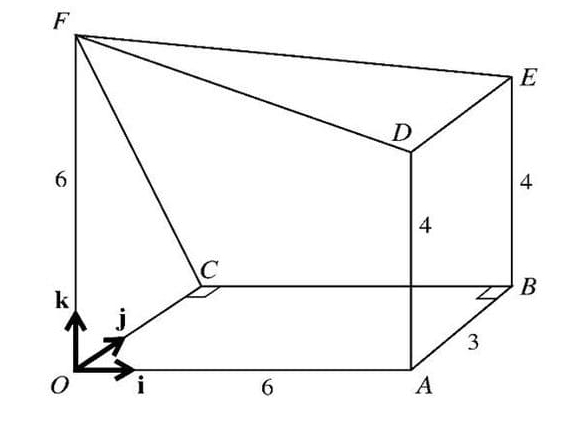
(i) To find \(\overrightarrow{DF}\), note that \(D\) is at \((6, 0, 4)\) and \(F\) is at \((0, 0, 6)\). Thus, \(\overrightarrow{DF} = (0 - 6)\mathbf{i} + (0 - 0)\mathbf{j} + (6 - 4)\mathbf{k} = -6\mathbf{i} + 2\mathbf{k}\).
(ii) To find \(\overrightarrow{EF}\), note that \(E\) is at \((6, 3, 4)\) and \(F\) is at \((0, 0, 6)\). Thus, \(\overrightarrow{EF} = (0 - 6)\mathbf{i} + (0 - 3)\mathbf{j} + (6 - 4)\mathbf{k} = -6\mathbf{i} - 3\mathbf{j} + 2\mathbf{k}\).
The magnitude of \(\overrightarrow{EF}\) is \(\sqrt{(-6)^2 + (-3)^2 + 2^2} = \sqrt{49} = 7\).
The unit vector in the direction of \(\overrightarrow{EF}\) is \(\frac{1}{7}(-6\mathbf{i} - 3\mathbf{j} + 2\mathbf{k})\).
(iii) To find angle \(EFD\), use the scalar product: \(\overrightarrow{DF} \cdot \overrightarrow{EF} = (-6\mathbf{i} + 2\mathbf{k}) \cdot (-6\mathbf{i} - 3\mathbf{j} + 2\mathbf{k}) = 36 + 4 = 40\).
The magnitudes are \(|\overrightarrow{DF}| = \sqrt{40}\) and \(|\overrightarrow{EF}| = 7\).
Thus, \(\cos \angle EFD = \frac{40}{7\sqrt{40}}\).
Therefore, \(\angle EFD = 25.4^\circ\).