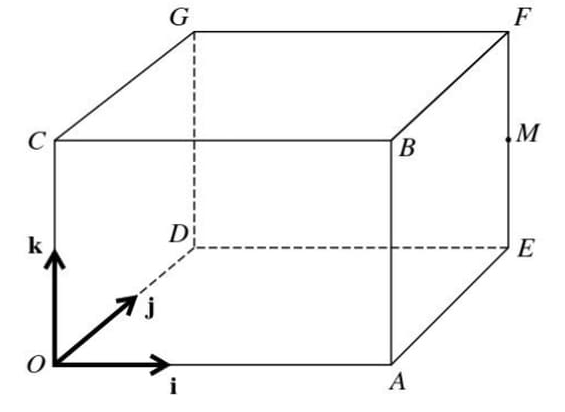
(a) The position vector of M is the midpoint of EF. Since E is at (3, 2, 0) and F is at (3, 2, 2), the midpoint M is at (3, 2, 1). Therefore, the position vector of M is \(3\mathbf{i} + 2\mathbf{j} + \mathbf{k}\).
(b) To calculate angle PAM, find vectors \(\overrightarrow{AM}\) and \(\overrightarrow{AP}\):
\(\overrightarrow{AM} = (3\mathbf{i} + 2\mathbf{j} + \mathbf{k}) - (3\mathbf{i}) = 2\mathbf{j} + \mathbf{k}\)
\(\overrightarrow{AP} = (\mathbf{i} + \mathbf{j} + 2\mathbf{k}) - (3\mathbf{i}) = -2\mathbf{i} + \mathbf{j} + 2\mathbf{k}\)
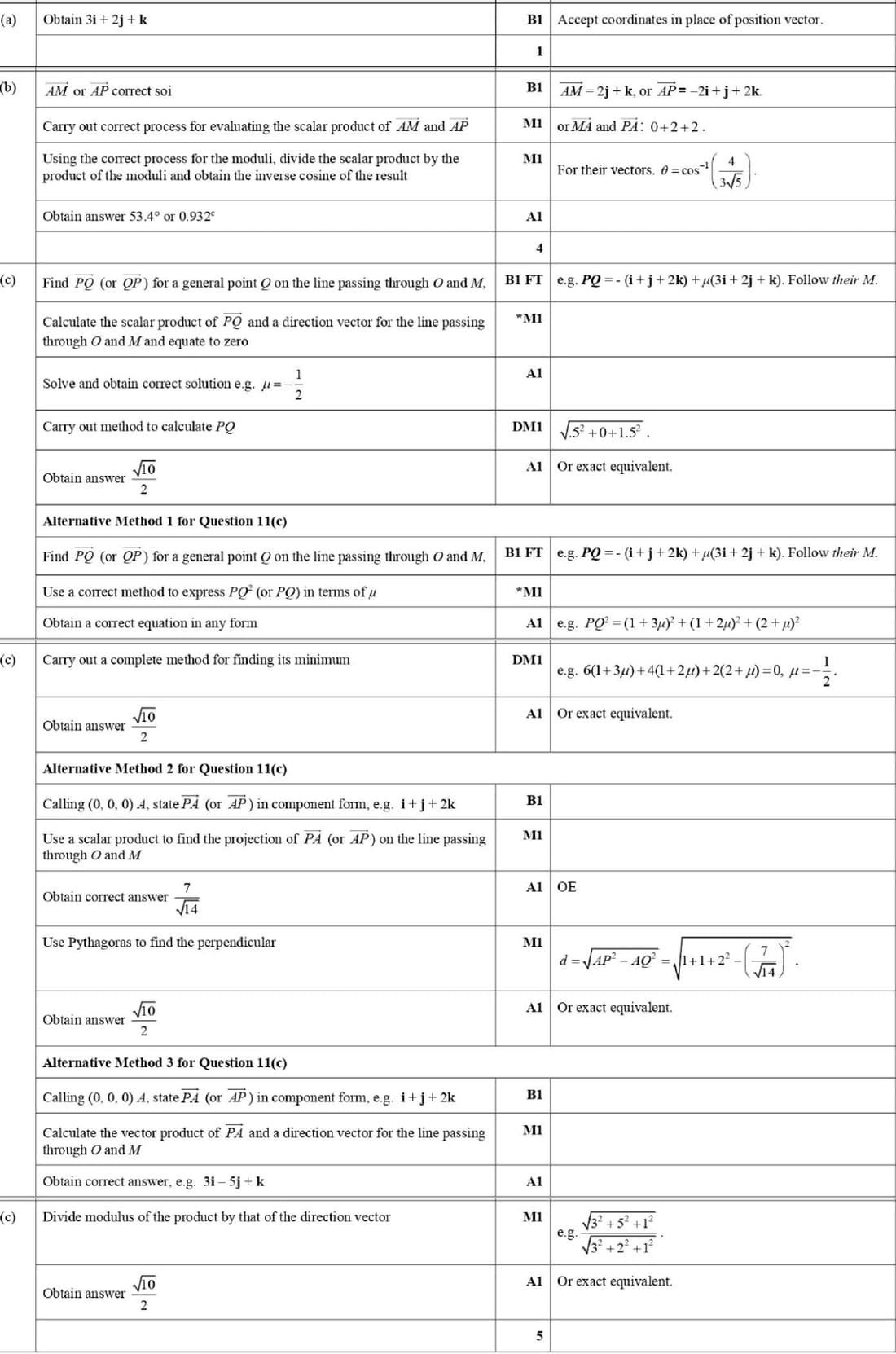
Calculate the dot product: \(\overrightarrow{AM} \cdot \overrightarrow{AP} = 0 + 2 \times 1 + 1 \times 2 = 4\)
Find the magnitudes: \(|\overrightarrow{AM}| = \sqrt{2^2 + 1^2} = \sqrt{5}\), \(|\overrightarrow{AP}| = \sqrt{(-2)^2 + 1^2 + 2^2} = \sqrt{9} = 3\)
Use the cosine formula: \(\cos \theta = \frac{4}{\sqrt{5} \times 3}\)
\(\theta = \cos^{-1}\left(\frac{4}{3\sqrt{5}}\right) \approx 53.4^\circ\)
(c) To find the perpendicular from P to the line through O and M, express PQ for a general point Q on the line:
\(\overrightarrow{PQ} = (\mathbf{i} + \mathbf{j} + 2\mathbf{k}) + \mu(3\mathbf{i} + 2\mathbf{j} + \mathbf{k})\)
Calculate the scalar product of \(\overrightarrow{PQ}\) and the direction vector \(3\mathbf{i} + 2\mathbf{j} + \mathbf{k}\) and equate to zero to find \(\mu\).
Solve to find \(\mu = -\frac{1}{2}\).
Calculate \(PQ\) using \(\mu\):
\(PQ = \sqrt{5 + 0 + 1.5^2} = \frac{\sqrt{10}}{2}\)