9709 P1 - Nov 2002 - Q7
2226
Given that \(\mathbf{a} = \begin{pmatrix} 2 \\ -2 \\ 1 \end{pmatrix}, \mathbf{b} = \begin{pmatrix} 2 \\ 6 \\ 3 \end{pmatrix}\) and \(\mathbf{c} = \begin{pmatrix} p \\ p \\ p+1 \end{pmatrix}\), find
(i) the angle between the directions of \(\mathbf{a}\) and \(\mathbf{b}\),
(ii) the value of \(p\) for which \(\mathbf{b}\) and \(\mathbf{c}\) are perpendicular.
Solution
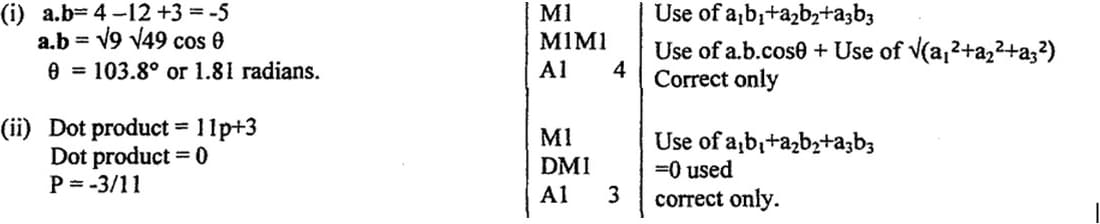
(i) To find the angle \(\theta\) between \(\mathbf{a}\) and \(\mathbf{b}\), use the dot product formula:
\(\mathbf{a} \cdot \mathbf{b} = a_1b_1 + a_2b_2 + a_3b_3 = 2 \times 2 + (-2) \times 6 + 1 \times 3 = 4 - 12 + 3 = -5\).
The magnitudes are \(|\mathbf{a}| = \sqrt{2^2 + (-2)^2 + 1^2} = \sqrt{9} = 3\) and \(|\mathbf{b}| = \sqrt{2^2 + 6^2 + 3^2} = \sqrt{49} = 7\).
Using \(\mathbf{a} \cdot \mathbf{b} = |\mathbf{a}| |\mathbf{b}| \cos \theta\), we have:
\(-5 = 3 \times 7 \times \cos \theta\).
\(\cos \theta = -\frac{5}{21}\).
\(\theta = \cos^{-1}\left(-\frac{5}{21}\right) \approx 103.8^\circ\) or \(1.81\) radians.
(ii) \(\mathbf{b}\) and \(\mathbf{c}\) are perpendicular if \(\mathbf{b} \cdot \mathbf{c} = 0\).
\(\mathbf{b} \cdot \mathbf{c} = 2p + 6p + 3(p+1) = 11p + 3\).
Set \(11p + 3 = 0\) to find \(p\).
\(11p = -3\).
\(p = -\frac{3}{11}\).